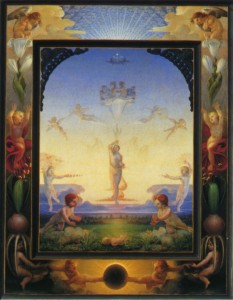
The Aurora
The Dawning of the Day in the East,
or Morning Redness in the rising of the SUN
Preface
7. The garden of this tree signifieth the world; the soil or mould
signifieth nature; the stock of the tree signifies the stars; by the branches
are meant the elements; the fruit which grow on this tree signify men; the sap
in the tree denoteth the pure Deity. Now men were made out of nature, the
stars, and elements; but God the Creator reigneth in all: even as the sap doth
in the whole tree.
8. But there are two qualities in nature, even until the Judgment of God: The
one is pleasant, heavenly and holy; the other is fierce, wrathful, hellish and
thirsty.
9. Now the good one qualifieth and worketh continually with all industry to
bring forth good fruit, and the Holy Ghost reigneth therein, and affords
thereunto sap and life: the bad one springeth and driveth with all its endeavor
to bring forth bad fruit continually, to which the devil affordeth sap and
hellish flame. Now both are in the tree of nature, and men are made out of that
tree, and live in this world, in this garden, between both, in great danger;
suddenly the sun shineth on them; by and by, winds, rain, and snow fall on
them.
16. But now man is poisoned through sin, that the fierce wrathful quality,
as well as the good, reigneth in him, and he is now half dead, and in his gross
ignorance can no more know God his Creator, nor nature and its operation: Yet
bath nature used its best endeavours from the beginning till now, to which God
bath given his Holy Ghost, so that it [nature] hath at all times generated
wise, holy, and understanding men, who learned to know nature, and their
Creator, and who always in their writings and teachings have been a light to
the world whereby God bath raised his Church on earth, to his eternal praise
Against which the devil bath raged, and spoiled many a noble twig through the
wrathful fierceness in nature, whose prince and god he is
21. Also it is clearly seen by the first world, as also by the second, even
unto the end of our time, how the heavenly and the hellish kingdom in nature
have always wrestled the one with the other, and stood in great travail, even
as a woman in the birth.
26. But when the tree of nature came to its middle age, then it began to
bear some mild and sweet fruit, to shew that it would henceforth bear pleasant
fruit. Then were born the holy prophets, out of the sweet branch of the tree,
who taught and preached of the light, which here after should overcome the
wrathful fierceness in nature. And the there arose a light in nature among the
Heathen, so that they knew nature, and her operation, although this was a light
in the wild nature only, and was not yet the holy light.
27. For the wild nature was not yet overcome, and light and darkness wrestled
so long the one with the other, till the sun arose, and with in heat forced
this tree, so that it did bear pleasant sweet fruit; that is, ti there came the
Prince of Light, out of the heart of God, and be can man in nature, and
wrestled in his human body, in the power of if divine light, in the wild
nature. That same Prince and Royal Twig grew up in nature, and became a tree in
nature, and spread its branches abroad from the east to the west; and
encompassed if whole nature, and wrestled and fought with the fierce wrath
which was in nature, and with the prince thereof, till he overcame and
triumphed, as a king in nature, and took the prince of wrath or fierceness
captive in his own house [Psalms 68].
The Contents Of This Book
6. The supreme title is AURORA, that is, The Dawning of the Day in the East,
or Morning Redness in the rising of the SUN. It is a secret Mystery, concealed
from the wise and prudent of this world, of which they themselves shall shortly
be sensible: But to those who read this book in singleness of heart, with a
desire after the Holy Spirit, who place their hope in God only, it will not be
a hidden secret, but a manifest knowledge.
7. I will not explain this title, but commit it to the judgment of the
impartial Reader, who wrestleth in the good quality of this world.
8. Now if Mr. Critic, who qualifieth or worketh with his wit in the fierce
quality, gets this book into his hand, he will oppose it, as there is always a
stirring and opposition between the kingdom of heaven and the kingdom of
hell.
- I. First, he will say that I ascend too high into the Deity, which is not a
meet thing for me to do.
- II. Then, secondly, he will say that I boast of the Holy Spirit, and that I
had more need to live accordingly, and make demonstration of it by wondrous
works or miracles.
- III. Thirdly, he will say that I am not learned enough.
- IV. Fourthly, he will say that I do it in a vainglorious way.
- V. Fifthly, he will be much offended at the simplicity of the author; for
in the world it is usual [or customary] to be mindful only of high things, and
to be irritated by simplicity.
15. So neither can I say anything of myself, nor boast or write of anything,
save this: that I am a simple man, and, besides, a poor sinner, and have need
to pray daily, Lord, forgive us our sins; and to say with the Apostle, 0 Lord,
thou hast redeemed us with thy blood.
16. Neither did I ascend into heaven, and behold all the works and creatures of
God; but the same heaven is revealed in my spirit, so that in the spirit I know
the works and creatures of God.
17. Besides, the will to that is not my natural will, but it is the impulse of
the spirit; and for it I have endured many an assault of the devil.
33. Time past, present, and to come, as also depth and height, near and afar
off, are all one in God, one comprehensibility.
34. The holy soul of man seeth the same also, but in this world in part only.
It happeneth sometimes that it seeth nothing at all, for the devil doth assault
it furiously in the fierce wrathful source that is in the soul, and oftentimes
covereth the noble mustard-seed; therefore man must always be at strife [or in
conflict].
The First Chapter
OF SEARCHING OUT THE DIVINE BEING IN NATURE:
OF BOTH THE QUALITIES, THE GOOD AND THE EVIL.
1. Though flesh and blood cannot conceive or apprehend the being of God, but
the spirit only when enlightened and kindled from God:
2. Yet if a man will speak of God, and say what God is, then,
- I. A man must diligently consider the powers in nature.
- II. Also the whole creation, heaven and earth.
- III. The stars, the elements, and the creatures that are proceeded from
them. As also the holy angels, devils, and men; moreover, heaven and
hell.
Of the Two Qualities in One.
3. In this consideration ate found two qualities, a good one and an evil
one, which are in each other as one thing in this world, in all powers, in the
stars and the elements, as also in all the creatures; and no creature in the
flesh, in the natural life, can subsist, unless it bath the two qualities.
What a Quality is.
4. Now here a man must consider what the word quality meaneth or is. A
quality is the mobility, boiling, springing and driving of a thing.
Of Heat.
5. As for example, heat, which burneth, consumeth and driveth forth all
whatsoever that cometh into it which is not of the same property; and again, it
enlighteneth and warmeth all cold, wet and dark things; it compacteth and
hardeneth soft things.
Of Light and Fierceness.
6. Heat containeth likewise two other kinds in it, namely, (1) Light, and
(2) Fierceness; of which take notice in this manner. The light, or the heart of
the heat, is in itself a pleasant, joyful glance or lustre, a power of life, an
enlightening and glance of a thing which is afar off, which light is a piece or
source of the heavenly kingdom of joy.
7. For it maketh living and moving all things in this world. All flesh, trees,
leaves and grass grow in this world in the power of the light, and have their
life therein, viz, in the good.
8. Again, heat containeth also a fierceness or wrath, which burneth, consumeth
and spoileth; this wrath or fierceness springeth, driveth and elevateth itself
in the light, and maketh the light moveable.
9. Heat wrestleth and fighteth together in its twofold source as one thing: It
is also one thing, but it bath a double source.
The Second Chapter
AN INTRODUCTION, SHEWING HOW MEN MAY COME TO APPREHEND THE
DIVINE, AND THE NATURAL, BEING. AND FURTHER OF THE TWO
QUALITIES.
1. All whatsoever that bath been mentioned above is called quality, because
it qualifieth, operateth or frameth all in the deep above the earth, also upon
the earth and in the earth, in one another, as ONE thing, and yet bath several
distinct virtues and operations, and but one mother, from whence descend and
spring all things.
2. All the creatures are made and descended from these qualities, and live
therein as in their mother; and the earth and stones descend or proceed from
thence also; and all that groweth out of the earth liveth and springeth forth
out of the virtue of these qualities; no rational man can deny it.
3. Now this twofold source, good and evil, in everything, is caused by the
stars; for as the creatures in the earth are, in their qualities, so also are
the stars.
4. For from its twofold source, everything hath its great mobility, running,
springing, driving and growing. For meekness in nature is a still rest, but the
fierceness in every power maketh all things moveable, running and
generative.
5. For the driving qualities cause a lust in all creatures unto evil and good,
so that all [things] are desirous one of another, to copulate and increase,
decrease, grow fair, perish, love and hate.
Of the Quality of the Sun.
15. If thou wilt be a philosopher and naturalist, and search into God's
being in nature, and discern how all is come to pass, then pray to God for the
Holy Spirit, to enlighten thee with it.
16. For in thy flesh and blood thou art not able to apprehend it, and though
thou dost read it, yet it is but as a fume or mist before thine eyes.
17. In the Holy Ghost alone, who is in God, and also in the whole nature, out
of which all things were made, in him alone canst thou search into the whole
body or corporeity of God, which is nature; as also into the Holy Trinity
itself.
18. For the Holy Ghost goeth forth from the Holy Trinity, and reigneth and
ruleth in the whole body or corpus of God; that is, in the whole nature.
19. Even as the spirit of man ruleth and reigneth in the whole body, in all the
veins, and replenisheth the whole man; even so the Holy Ghost replenisheth the
whole nature, and is the heart of nature, and reigneth in the good qualities of
everything.
20. Now, if thou hast that spirit in thee, so that it enlighteneth, filleth and
replenisheth thy spirit, then thou wilt understand what followeth in this
writing.
21. But if not, then it will be with thee as it was with the wise Heathen, who
gazed and stared on the creation, and would search and sift it out by their own
reason; and though with their fictions and conceits they came before God's
countenance or face, yet they were not able to see it, but were stark blind in
the knowledge of God.
22. As the Children of Israel in the desert could not behold the countenance of
Moses, and therefore, when he drew near to the people, he must put a veil
before his face.
23. The cause of this was, that they neither understood nor knew the true God
and his will, who, notwithstanding, walked among them; and therefore that veil
was a sign and type of their blindness and misunderstanding.
24. As little as a piece of work can apprehend him that made it, so little also
can man apprehend and know God his Creator, unless the Holy Ghost enlighten
him; which happeneth only to those that rely not upon themselves, but set their
hope, will and desires upon God alone, and move in the Holy Ghost, and these
are one spirit with God.
25. Now if we consider rightly of the sun and stars, with their corpus or body,
operations and qualities, then the very divine being may be found therein, and
we may find that the virtues of the stars are nature itself.
28. But here thou must elevate thy mind in the spirit, and consider how the
whole nature, with all the powers which are in nature, also the wideness, depth
and height, also heaven and earth, and all whatsoever is therein, and all that
is above the heavens, is together the body or corporeity of God; and the powers
of the stars are the fountain veins in the natural body of God in this
world.
29. Thou must not conceive that in the body of the stars is the triumphing Holy
Trinity, God the Father, Son, and Holy Ghost, in which there is no evil, for it
is the light-holy, eternal fountain of joy, which is indivisible and
unchangeable, which no creature can sufficiently apprehend or express; which
dwelleth and is above the body of the stars in itself, whose depth no creature
is able to measure or fathom.
30. But we must not so conceive as if God were not at all in the corpus or body
of the stars, and in this world: For when we say, ALL, or from eternity to
eternity, or All in All, then we understand the entire GOD.
31. For a similitude or example take man, who is made after the image or
similitude of God, as it is written [Genesis 1:27].
79. This indeed hath been partly concealed from the beginning of the world
to this time, and man with his reason could not comprehend it.
80. But seeing God is pleased to reveal himself in simplicity in this last
time, I shall give way to his impulse and will; I am but a very little spark of
light. AMEN.
The Third Chapter
OF THE MOST BLESSED TRIUMPHING, HOLY, HOLY, HOLY TRINITY,
GOD THE FATHER, SON, AND HOLY GHOST, ONE ONLY GOD.
13. When we consider the whole nature and its property, then we see the
Father.
14. When we behold heaven and the stars, then we behold his eternal power and
wisdom: So many stars stand in the whole heaven that they are innumerable and
incomprehensible to reason, and some of them are not visible, so manifold and
[so] various is the power and wisdom of God the Father.
Observe here the great Mystery of God.
53. Further, the sun is made or generated from all the stars, and is a light
taken from the whole nature, and shineth again into the whole nature of this
world; it is united with the other stars, as if itself together with all the
stars were but one star.
Of the Holy TRINITY
80. Now when we speak or write of the three Persons in the Deity, you must
not conceive that therefore there are three Gods, each reigning and ruling by
himself, like temporal kings on the earth.
81. No: such a substance and being is not in God; for the divine being
consisteth in power, and not in body or flesh.
82. The Father is the whole divine power, whence all creatures have proceeded,
and hath been always, from eternity: He hath neither beginning nor end.
83. The Son is in the Father, being the Father's Heart or light, and the Father
generateth the Son continually, from eternity to eternity; and the Son's power
and splendour shine back again in the whole Father, as the sun doth in the
whole world.
84. The Son is also another Person than the Father, but not externally, without
or severed from the Father, nor is he any other God than the Father is; his
power, splendour, and omnipotence, are no less than the whole Father.
85. The Holy Ghost proceedeth from the Father and the Son, and is the third
self-subsisting Person in the Deity. As the elements in this world go forth
from the sun and the stars, and are the moving spirit which is in everything in
this world,
86. So the Holy Ghost is the moving spirit in the whole Father, and proceedeth
or goeth forth from eternity to eternity continually from the Father and the
Son, and replenisheth the whole Father; he is nothing less or greater than the
Father and the Son; his moving power is in the whole Father.
109. Thus you find in everything a similitude of the Ternary in the divine
being, look upon what you will; let no man make himself so stark blind as to
think otherwise, or to think that God hath no Son and no Holy Ghost.
110. I shall make this more plain and clear when I come to write of the
creation; for I do not borrow of other men in my writings: And though indeed I
quote many examples and testimonies of God's saints, yet all is written by God
in my mind, so that I absolutely and infallibly believe, know and see it; yet
not in the flesh, but in the spirit, in the impulse and motion of God.
111. It is not so to be understood that my reason is greater or higher than
that of all other men living; but I am the Lord's twig or branch, and am a very
mean and little spark of his; he may set me where he pleaseth, I cannot hinder
him in that.
112. Nor is this my natural will, that I could do it by my own small ability;
for if the spirit were withdrawn from me, then I could neither know nor
understand my own writings; and I must on every side fight and struggle with
the devil, and lie open to temptation and affliction as well as other men.
113. But in the following chapters you will soon see the devil and his kingdom
laid naked; his pride and reproach shall suddenly be discovered.
The Fifth Chapter
OF THE CORPOREAL SUBSTANCE, BEING AND PROPRIETY OF AN
ANGEL.
29. Here I write not without knowledge; but if thou, like an epicure and
fatted swine of the devil, from the devil's instigation, shouldst mock at these
things and say:
30. The fool surely hath not gone up to heaven and seen or heard them, these
are mere fables; then, in the power of my knowledge, I would have you warned,
and cited before the severe judgment of God.
Question.
35. The question now is, What manner of qualification hath an angel?
Answer.
36. The holy soul of a man, and the spirit of an angel, are and have one and
the same substance and being, and there is no difference therein, but only in
the quality itself, or in their corporeal government; that which qualifieth
outwardly, or from without, in man by the air hath a corrupt earthly quality,
yet on the other side, hidden from the creatures, it hath also a divine and
heavenly quality. 37. But the holy soul understandeth it well, as the kingly
prophet David saith, The Lord rideth on the wings of the wind [Psalms 104:3].
In the angel the divine property qualifies only in perfect holiness, divinity
and purity.
Question.
38. But a simple man may ask, What do you mean by the word qualifying, or
what is that?
Answer.
39. I mean thereby the power, which in the body of the angel entereth in
from without, and cometh forth again; as in a similitude, when a man fetcheth
breath and breatheth it forth again; for therein standeth the life both of the
body and of the spirit.
The Seventh Chapter
OF THE COURT, PLACE AND DWELLING, ALSO THE GOVERNMENT
OF ANGELS, HOW THESE THINGS STOOD AT THE BEGINNING,
AFTER THE CREATION, AND HOW THEY BECAME AS THEY ARE.
Observe:
40. The Father's power is all, in and above all heavens, and the same power
everywhere generateth the light. Now this UNIVERSAL POWER is, and is called,
the universal power of the Father; and the light which is generated out of that
universal power is, and is called, the Son.
41. But it is therefore called the Son, in that it is generated out of the
Father, so that it is the Heart of the Father in his powers.
42. And being generated, it is another person than the Father is; for the
Father is the power and the kingdom, and the Son is the light and the splendour
in the Father, and the Holy Ghost is the moving or exit out of the powers of
the Father and of the Son, and formeth, figureth, frameth and imageth all.
46. Now if a man should say the Son of God were an image, circumscriptive or
measurable like the sun, then the three Persons would be only in that place
where the Son is, and his splendour or shining would be without or beyond him,
and as gone forth from the Son; and the Father would be one, only externally,
without or beside the Son, and then the power of the Father, which would be
afar off and wide distant from the Son, would not generate the Son and Holy
Ghost, externally, without and beyond the angelical gates; and so there would
be an unalmighty being, externally, without or beside this place of the Son;
and, moreover, the Father would be a circumscribed or measurable being.
47. Which is not so: But the Father everywhere generateth the Son out of all
his powers, and the Holy Ghost goeth everywhere forth from the Father and the
Son, and so there is but ONE only God in one being, with three distinct
persons.
48. Of which you have a similitude in the precious gold ore, or a goldstone
unseparated. First there is the matter, that is, the Salitter and Mercurius,
which is the mother or the whole stone, which generateth the gold everywhere in
the whole stone; and in the gold is the glorious power or virtue of the
stone.
51. Thus also is the place or space in the centre or midst of the angelical
gates a more pleasant, more gracious, amiable and blessed place to the Father,
wherein his Son and Heart is generated in the most richly and fully loving
manner, and wherein the Holy Ghost goeth forth from the Father and the Son in
the most richly and fully loving manner.
52. Thus you have the right ground of this Mystery, and you ought not to think
that the Son of God was generated of the Father at once, at a certain time, as
one that hath a beginning, and that he standeth now as a king, and would be
worshipped.
53. No; this would not be an eternal Son, but one that had a beginning, and was
under, beneath or inferior to the Father that had generated him.
54. Neither would he be all-knowing, for he could not know how it was before
his Father had generated him.
55. But the Son is generated continually from eternity unto eternity, and
shineth continually from eternity into the powers of the Father again, whereby
the powers of the Father are always from eternity to eternity continually
impregnated with the Son, and generate him continually.
56. Out of which the Holy Ghost continually existeth from eternity to eternity,
and so continually from eternity to eternity goeth forth from the Father and
the Son, and hath neither beginning nor end.
70. But here I will shew thee the right Mystery. Behold, the sun is the
heart of all powers in this world, and is compacted, framed or composed out of
all the powers of the stars, it re-enlighteneth all the stars, and all the
powers in this world, and all powers grow active, operative or qualifying in
its power.
[71. "Understand it magically: For it is a mirror, looking-glass, or similitude
of the eternal world."]
The Eighth Chapter
OF THE WHOLE CORPUS OR BODY OF AN ANGELICAL KINGDOM.
Question.
21. Now the question is, What in heaven is the wrath of God? And whether God
be angry in himself; or how is God moved to anger?
Answer.
Here there are chiefly seven sorts of qualities or circumstances to be
observed.
I. Of the First Species or Circumstance.
22. First: In the divine power there is, hidden in secret, the astringent
quality, which is a quality of the kernel, pith or hidden being, a sharp
compaction or penetration in the Salitter, very sharp and harsh or astringent,
which generates hardness, and also coldness; and when the astringent quality is
kindled it generateth a sharpness like unto salt.
II. Of the Second Species or Circumstance.
32. The Second quality, or second spirit of God in the divine Salitter, or
in the divine power, is the sweet quality, which worketh in the astringent, and
mitigateth the astringent, so that it is altogether lovely, pleasant and mild
or meek.
33. For it is the overcoming of the astringent quality, and is the very source
or fountain of the mercy of God, which overcometh the wrath, whereby the
astringent harsh source is mollified, and God's mercy riseth up.
III. Of the Third Circumstance or Species.
44. The Third quality, or the third spirit of God in the Father's power, is
the bitter quality; which is a penetrating or forcing of the sweet and the
astringent or harsh qualities, and which is trembling, penetrating and rising
up.
48. The bitter quality is the first spirit from whence mobility taketh its
original, whence the life becometh stirring, and is well called Cor or the
heart, for it is the trembling, shivering, elevating, penetrating spirit, a
triumphing or joy, an elevating source of laughing; in the sweet quality the
bitter is mollified, so that it becometh very richly loving and joyful.
49. But if it be moved, elevated and kindled too much, then it kindleth the
sweet and the astringent or harsh qualities, and is like a tearing, stinging
and burning poison, as when a man is tormented with a raging plague-sore, which
maketh him cry out for woe and misery.
IV. Of the Fourth Circumstance or Species.
59. The Fourth quality, or the fourth fountain-spirit in the divine power of
God the Father, is the heat, which is the true beginning of life, and also the
true spirit of life.
60. The astringent or harsh and sour quality, and the sweet, are the Salitter,
which belongeth to the body, out of which the body is framed.
61. For coldness and hardness stand in the astringent quality, and are a
contraction and drying; and in the sweet quality stand the water, and the light
or shining-ness, and the whole matter of the body.
62. And the bitter quality is the separation and forming, and the heat is the
spirit, or the kindling of the life, whereby the spirit existeth in the body,
which [spirit] springeth or moveth in the whole body, and shineth out from the
body, and also maketh the living motion in all the qualities of the body.
63. Two things chiefly are to be eyed in all the qualities: If you look upon a
body you first see the stock or pith, or the kernel of all the qualities, which
is framed or composed out of all the qualities; for to the body belong the
astringent or harsh, sour, sweet, bitter and hot qualities; these qualities
being dried together, make the body or stock.
The Great Mystery of the Spirit.
64. Now in the body these qualities are mixed, as if they all were but one
quality; yet each quality moveth or boileth in its own power, and so goeth
forth.
65. Each quality goeth forth from itself into the others, and toucheth or
stirreth the others, that is, it affecteth the others, whereby the other
qualities get the will of this quality; that is, they prove the sharpness and
spirit of this, as to what is in it, and always mix with it continually.
V. Of the Fifth Circumstance or Species.
155. The Fifth quality, or the fifth spirit of God among the seven spirits
of God, in the divine power of the Father, is the gracious, amiable, blessed,
friendly and joyful love.
156. Now observe what is the fountain of the gracious, amiable, blessed and
friendly love of God; observe it exactly, for it is the very pith, marrow or
kernel.
164. 0 noble guest! 0, why didst thou depart from us! 0 fierceness, wrath
and astringency or severity, thou art the cause of it! 0 fierce wrathful devil!
0, what hast thou done, who hast sunk down thyself and thy beautiful bright
angels into darkness? Woe, woe for ever!
165. 0, was not the gracious, amiable, blessed and fair love in thee also? 0
thou high and lofty-minded devil! Why wouldst thou not be contented? Wert thou
not a Cherubim? and was there anything so beautiful and bright in heaven as
thou? For what didst thou seek? Wouldst thou be the whole or total God? Didst
thou not know that thou wert a creature, and hadst not the fan and
casting-shovel in thy own hand or power?
166. 0, why do I pity thee, thou stinking goat? 0 thou cursed stinking devil!
how hast thou spoiled us? How wilt thou excuse thyself? What wilt thou object
to me?
Objection.
167. Thou sayest, if thy fall had not been, man would never have been
thought of.
Answer.
0 thou lying devil! Though that should be true, yet the Salitter out of
which man is made (which is also from eternity, as well as that out of which
thou art made), had stood in eternal joy and bright glory, and had likewise
risen up in God, and had tasted of the gracious, amiable, blessed love in the
seven spirits of God, and enjoyed the heavenly joy.
The Ninth Chapter
OF THE GRACIOUS, AMIABLE, BLESSED, FRIENDLY AND MERCIFUL LOVE OF
GOD.
21. Now observe, The gracious, amiable, blessed love, which is the fifth
fountain-spirit in the divine power, is the hidden source, fountain or quality
which the corporeal being cannot comprehend or apprehend, but only when it
riseth up in the body, and then the body triumpheth therein, and behaveth
itself friendly, lovely and courteously; for that quality or spirit belongeth
not to the imaging or framing of a body, but riseth up in the body, as a flower
springeth up out of the earth.
22. Now this fountain-spirit taketh its original at first out of the sweet
quality of the water.
Observe:
74. The seven spirits of God, in their circumference and space, contain or
comprehend heaven and this world; also the wide breadth and depth without and
beyond the heavens, even above and beneath the world, and in the world, yea the
whole Father, who hath neither beginning nor end.
75. They contain also all the creatures both in heaven and in this world; and
all the creatures in heaven and in this world are imaged, fashioned or framed
out of these spirits, and live in them as in their own propriety.
76. Their life and their reason is generated in them in such a manner as the
divine being is generated, and also in the same power.
77. Out of and from the same body of the seven spirits of God are all things
made and produced, all angels, all devils, the heaven, the earth, the stars,
the elements, men, beasts, fowls, fishes; all worms, wood trees, also stones,
herbs and grass, and all whatsoever is.
The Tenth Chapter
OF THE SIXTH QUALIFYING OR FOUNTAIN SPIRIT IN THE DIVINE
POWER.
1. The Sixth qualifying or fountain spirit in the divine power is the sound,
tone, tune or noise, wherein all soundeth and tuneth; whence ensued speech,
language, and the distinction of everything, as also the ringing melody and
singing of the holy angels, and therein consisteth the forming or framing of
all colours, beauty and ornament, as also the heavenly joyfulness.
Question.
2. But thou wilt ask, What is the tone or sound? Or how taketh this spirit
its source and original?
Answer.
3. All the seven spirits are generated one in another, the one continually
generateth the other, not one of them is the first, nor is any one of them the
last; for the last generateth as well the first as the second, third, fourth,
and so on to the last.
4. But why one is called the first, another the second, and so on, that is in
respect to that which is the first in order to the imaging, framing and forming
of a creature.
5. For all the seven are equally eternal, and none of them hath either
beginning or end; and therefore, in that the seven qualities are continually
generating one another, and that none is without the other, it followeth that
there is ONE Only Eternal Almighty GOD.
31. But here thou must know that one spirit alone can not generate another,
neither can two of them do it, but the birth of a spirit standeth in the
operation of all the seven spirits, six of them always generate the seventh,
and so if one of them were not, then the others would not be either.
32. But that I sometimes take only two or three to the nativity or birth of a
spirit, I do that because of my own weakness, for in my corrupted brain I
cannot bear them all seven at once in their perfection.
33. I see them all seven very well, but when I speculate into them, then the
spirit riseth up in the middlemost fountain or well-spring, where the spirit of
life generateth itself, which goeth now upwards, now downwards, it cannot
apprehend all the seven spirits in one thought, or at once, but only in
part.
34. Every spirit hath its own quality or source, though indeed it is generated
of the others; and so it is with the apprehension of man; he hath indeed the
fountain of all seven spirits in him, but in what quality or fountain soever
the spirit riseth up, the qualifying or fountain spirit thereof, wherein that
same spirit is most strongly imaged, is that [one] which he comprehendeth most
sharply in that rising up.
35. For even in the divine power one spirit, in its rising up, doth not go
through all the spirits equally at once; for when it riseth up, then indeed it
toucheth or stirreth them all at once, but it is caught in its rising up, so
that it must lay down its stateliness and pomp, and not triumph over all the
seven.
[36. "It is the being or substance of the senses and thoughts, otherwise, if a
thought through the centre of nature could penetrate all the forms, then it
were free from the band of nature. "]
45. I have read the writings of very high masters, hoping to find therein
the ground and true depth; but I have found nothing, but a half dead spirit,
which in anxiety travaileth and laboureth for health, and yet, because of its
great weakness, cannot attain perfect power.
46. Thus I stand yet as an anxious woman in travail, and seek perfect
refreshing, but find only the scent or smell or savour in its rising up,
wherein the spirit examineth what power sticketh in the true cordial, and in
the meanwhile refresheth itself in its sickness with that perfect smell or
savour, till the true Samaritan doth come, who will dress and bind up its
wounds and heal it, and bring it to the eternal inn or lodging, then shall it
enjoy the perfect taste.
47. This herb, which I mean here, from whose fragrancy my spirit taketh its
refreshing, every country ploughman doth not know it, nor every doctor, the one
is as ignorant of it as the other; it groweth indeed in every garden, but in
many it is quite spoiled and bad: for the quality of the soil or ground is in
fault. And therefore men do not know it, nay the children of this Mystery do
hardly know it; although this knowledge hath been very rare, dear and precious,
from the beginning of the world to this time.
48. Though in many men a source or fountain and quality hath riser up, but then
suddenly pride pressed after it, and spoiled all; whereupon it [pride] was
loath to write it down in its mother-tongue; it supposed that was too childish
a thing to do, it must shew it in a deeper language, that the world should see
that it is manly; and for its advantage it kept it [the source or fountain and
quality] in secret, and daubed it with deep strange names, that men might not
know it; such a beast is the devil's disease of pride.
Question.
74. Thou askest, How can a man quench this kindled fire?
Answer.
75. Hearken, thou hast the sweet water in thee, pour that into the fire, and
then the fire goeth out: If thou lettest it burn, then it consumeth in thee the
sap that is in all the seven qualifying or fountain spirits, so that thou wilt
become dry.
76. When that is done, then thou art a hellish fire-brand, and a billet or
faggot to lay upon the hellish fire, and then there is no remedy for thee
eternally.
81. But thou must know, that thou, in the government of thy mind, art thine
own lord and master, there will rise up no fire to thee in the circle or whole
circumference of thy body and spirit, unless thou awakenest it thyself.
82. It is true that all thy spirits spring and move in thee, and rise up in
thee, and indeed always one spirit hath more power in thee than [in] another
[man].
83. For if the government of the spirits were the same in one man as in
another, then we should all have one will and form; but all seven are in the
power of thy compacted incorporated spirit, which spirit is the SOUL.
[84. "It hath in it the first Principle; the spirit of the soul hath the
second; and the astral or starry spirit in the elements hath the third, viz,
this world."]
103. Yea, God is so near thee, that the birth or geniture of the Holy
Trinity is done or wrought even in thy heart, yea, all the three Persons are
generated in thy heart, even God the Father, Son, and Holy Ghost.
104. Now when I write here concerning the midst or centre, that the fountain of
divine birth or geniture is in the midst or centre, the meaning is not that in
heaven there is a peculiar or several place, or a peculiar several body,
wherein the fire of the divine life riseth up, out of which the seven spirits
of God go forth into the whole deep of the Father.
105. No; but I speak in a corporeal or angelical or human way that the Reader
may the better understand it, in such a manner as the angelical creatures were
imaged or framed, and as it is in God everywhere universally.
106. For thou canst not nominate any place, either in heaven or in this world,
wherein the divine birth or geniture is not thus, be it in an angel, or in a
holy man, or anywhere else.
107. Wheresoever one qualifying or fountain spirit in the divine power is
touched or stirred, let the place be where it will or the thing what it will
(except in the devils, and all wicked, damned men), there is the fountain of
the divine birth or geniture directly at hand, and there already are all the
seven qualifying or fountain spirits of God.
108. As when thou wouldst make a spacious, creaturely, circumscribed circle,
and hadst the whole Deity peculiarly apart therein. Just as the Deity is
generated in a creature, so it is also in the whole deep of the Father in all
places and parts thereof, and in all things.
The Eleventh Chapter
OF THE SEVENTH QUALIFYING OR FOUNTAIN SPIRIT IN THE DIVINE
POWER.
1. The Seventh spirit of God in the divine power is the corpus or body,
which is generated out of the other six spirits, wherein all heavenly figures
subsist, and wherein all things image and form themselves, and wherein all
beauty and joy rise up.
2. This is the very spirit of nature, yea nature itself, wherein
apprehensibility or comprehensibility consisteth, and wherein all creatures are
formed in heaven and on earth. Yea heaven itself is therein formed; and all
naturality in the whole God consisteth in this spirit.
3. If it were not for this spirit there would be neither angel nor man, and God
would be an unsearchable being, subsisting only in an unsearchable power.
Question
4. Now the question is: How is this form? Or in what manner is this so?
Answer
If thou art a rational mercurial spirit, which presseth through all the
seven spirits of God, and beholdeth, proveth and examineth them, how they are,
then thou wilt, by the explanation of this seventh spirit, conceive and
understand the operation and the being of the whole Deity, and apprehend it in
thy sense or mind.
11. Behold, all the seven spirits of God are generated alike together at
once; none of them is the first, and none of them is the last; but we must have
an eye to the kernel, and consider how the divine birth or geniture riseth up,
otherwise man understandeth it not.
12. For the creatures cannot comprehend at once all the seven spirits, one in
another, but they look upon them; but when one spirit is touched or stirred,
then that toucheth or stirreth all the others, and then the birth or geniture
standeth in full power.
13. Therefore it hath a beginning in man, but none in God; and therefore I must
also write in a creaturely manner, or else thou canst not understand it.
14. Behold, without the flash all the seven spirits were a dark valley, but
when the flash riseth up between the astringent and bitter qualities, in the
heat, then it becometh shining in the sweet water, and in the flames of the
heat it becometh bitter, and triumphing and living, and in the astringent it
becometh corporeal, dry and bright.
15. Now these four spirits move themselves in the flash, for all the four
become living therein, and so now the power of these four riseth up in the
flash, as if the life did rise up, and the power which is risen up in the flash
is the love, which is the fifth spirit.
16. That power moveth so very pleasantly and amiably in the flash, as if a dead
spirit did become living, and was suddenly in a moment set into great clarity
or brightness.
17. Now in this moving one power toucheth or stirreth another: First the
astringent beateth or striketh, and the heat maketh in that beating or stroke a
clear ringing sound, and the bitter power divideth the ringing, and the water
maketh it mild and soft, and mitigateth it; and this is the sixth spirit.
18. Now the tone in all the five spirits riseth up like a melodious pleasant
music, and remaineth so standing; for the astringent quality exsiccateth it or
drieth it up.
19. So now, in the same sound that is gone forth (which now subsisteth, being
dried) is the power of all the six qualifying or fountain spirits, and it is as
it were the seed of the other six spirits, which they have there compacted or
incorporated together, and made one spirit thereof, and which hath the quality
of all the spirits: and that is the seventh spirit of God in the divine
power.
22. The seven spirits are the father of the light, and the light is their
son, which they always continually generate thus from eternity to eternity, and
the light enlighteneth and always eternally maketh the seven spirits living and
joyful, for they all receive their rising and life in the power of light.
23. Again, they all generate the light, and all are together alike the father
of the light, and the light generateth no one spirit, but maketh them all
living and joyful, that they always continually stand in the birth.
The Holy Gates.
32. But the light, which subsisteth in the midst or centre in all the seven
spirits, and wherein standeth the life of all the seven spirits, whereby all
seven become triumphing and joyful, and wherein the heavenly joyfulness rises
up:
33. That is that which all the seven spirits generate, and that is the son of
all the seven spirits, and the seven spirits are its father, which generate the
light; and the light generateth in them the life; and the light is the heart of
the seven spirits.
34. This light is the true Son of God, whom we Christians worship and honour,
as the second Person in the Holy Trinity.
85. The seventh qualifying or fountain spirit of God is the qualifying or
fountain spirit of nature: for the other six do generate the seventh; and the
seventh, when it is generated, is then as it were the mother of the seven,
which encompasseth the other six, and generateth them again: for the corporeal
and natural being consisteth in the seventh.
102. Now as that quality is which is strongest, so the body of the fruit is
imaged, and the colours also; in this striving or wrestling the Deity formeth
itself into infinite and unsearchable variety of kinds and manners of images or
ideas.
103. For the seven spirits are the seven head sources or springs, and when
Mercurius riseth up therein, that stirreth all, and the bitter quality moveth
it, and distinguisheth it, and the astringent drieth it up.
[104. "Nature and the Ternary are not one and the same; they are distinct,
though the Ternary dwelleth in nature, but unapprehended, and yet is an eternal
band, as is plainly unfolded in our second and third books."]
139. But the cold and half-dead body doth not always understand this fight
of the soul: The body doth not know how it is with it, but is heavy and
anxious; it goeth from one room or business to another; and from one place to
another; it seeketh for ease and rest.
140. When it cometh thither, where it would be, yet it findeth no such thing;
then doubtings and unbelief fall in between and come upon it; sometimes it
seems to it as if God had quite cast it off; but it doth not understand the
fight of the spirit, how the same is sometimes down, and sometimes gets
aloft.
141. What vehement and furious war and fight there is between the hellish
quality and the heavenly, which fire the devils blow up, and the holy angels
quench it, I leave to every holy soul to consider of.
142. Thou must know that I write not here as a story or history, as if it were
related to me from another, but I must continually stand in that combat or
battle, and I find it to be full of heavy strivings, wherein I am often struck
down to the ground, as well as all other men.
143. But for the sake of the violent fight, and for the sake of the earnestness
which we have together, this revelation hath been given me, and the vehement
driving or impulse to bring it so to pass as to set all this down on paper.
144. But what the total sequel is, which may follow upon and after this, I do
not fully know: Only sometimes, future Mysteries in the depth are shewn to
me.
145. For when the flash riseth up in the centre, one seeth through and through,
but cannot well apprehend or lay hold on it; for it happeneth to such a one as
when there is a tempest of lightning, where the flash of fire openeth itself,
and suddenly vanisheth.
146. So it goes also in the soul, when it presseth or breaks quite through in
its flight or combat, then it beholdeth the Deity, as a flash of lightning; but
the source, quality or fountain of sins covereth it suddenly again: For the Old
Adam belongeth to the earth, and doth not, with this flesh, belong to the
Deity.
The Twelfth Chapter
OF THE NATIVITY AND PROCEEDING FORTH OR DESCENT OF THE HOLY ANGELS,
AS ALSO OF THEIR GOVERNMENT, ORDER, AND HEAVENLY JOYOUS LIFE.
Observe the Depth.
4. There are seven spirits of God, all these seven have moved them selves,
and the light therein hath moved itself also, and the spirit, which goeth forth
out of the seven spirits of God, hath moved itself also.
5. Now the Creator intended, according to his Ternary, to create three hosts,
not one from another, but one by another, as in a circle or sphere.
6. Now observe: As the spirits were therein in their moving, boiling or rising
up, so also were the creatures: In the midst or centre of each host was the
heart of each host incorporated or compacted together, out of which an
angelical or great or chief prince proceeded or came to be.
Question.
28. Why hath God created angel-princes and not made them all equal, or
alike?
Answer.
29. Behold, God is the God of order; and as it is, and as it goeth and
moveth in his government in himself, that is, in his birth or geniture, and in
his rising up, so also is the order of the angels.
30. Now as there are in him chiefly seven qualities, whereby the whole divine
being is driven on, and sheweth itself infinitely in these seven qualities, and
yet these seven qualities are the chief or prime in the infiniteness, whereby
the divine birth or geniture stands eternally in its order unchangeably:
31. And as in the midst or centre of the seven spirits of God the heart of life
is generated, whence the divine joy riseth up; thus also is the order of
angels.
Of his Creation.
134. As Michael is created according to the quality, manner and property of
God the Father, so was Lucifer created according to the quality, condition and
beauty of God the Son, and was bound to and united with him in love, as a dear
son or heart, and his heart also stood in the centre of light, as if he had
been God himself; and his beauty or brightness transcended all.
135. For his circumference, conception or chief mother, was the Son of God, and
there he stood as a king or prince of God.
136. His court, province, place, region or quarters, wherein he dwelt with his
whole army or company, and wherein he is become a creature, and which was his
kingdom, is the created heaven and this world, wherein we dwell with our King
JESUS CHRIST.
The Thirteenth Chapter
OF THE TERRIBLE, DOLEFUL, AND LAMENTABLE,
MISERABLE FALL OF THE KINGDOM OF LUCIFER.
22. But to me is shewn the ladder of Jacob, upon which I am climbed up, even
into heaven, and have received my ware, to offer for sale: Therefore if any one
will climb up after me, Let him take heed that he be not drunken, but he must
be girt with the sword of the spirit.
23. For he must climb through a horrible deep, a giddiness will frequently come
into his head; and besides, he must climb through the midst or centre of the
kingdom of hell, and there he will feel by experience what a deal of scoffings
and upbraidings he must endure.
24. In this combat I had many hard trials to my heart's grief: My sun was often
eclipsed or extinguished, but did rise again; and the oftener it was eclipsed
or put out, the brighter and clearer was its rising again.
44. But the seven spirits, which are in an angel, and which generate the
light and understanding, are bound and united with the whole God, that they
should not qualify any other way, either higher or more vehemently, than God
himself; but that there should be one and the same manner and way between them
both.
45. Seeing they are but a part or piece of the whole, and not the whole itself,
for God hath therefore created them out of himself, that they should qualify,
operate or act in such a manner, form and way as God himself doth.
46. But now the qualifying or fountain spirits in Lucifer did not so; but they,
seeing that they sat in the highest primacy or rank, moved themselves so hard
and strongly that the spirit which they generated was very fiery, and climbed
up in the fountain of the heart, like a proud damsel or virgin.
54. But when they elevated themselves in a sharp or strong kindling, then
they did against nature's right otherwise than God their Father did, and this
was a stirring quality or rising up against or contrary to the whole Deity.
55. For they kindled the Salitter of the body, and generated a high triumphing
son, which in the astringent quality was hard, rugged or rough, dark and cold,
and in the sweet was burning, bitter and fiery; the tone was a hard fiery
noise; the love was a lofty enmity against God.
56. Here now stood the kindled bride in the seventh nature-spirit, like a proud
beast; now she supposed she was beyond or above God, nothing was like her now:
Love grew cold, the Heart of God could not touch it, for there was a contrary
will or opposition between them. The Heart of God moved very meekly and
lovingly, and the heart of the angel moved very darkly, hard, cold and
fiery.
Now observe:
65. The whole Deity hath in its innermost or beginning birth, in the pith or
kernel, a very tart, terrible sharpness, in which the astringent quality is a
very horrible, tart, hard, dark and cold attraction or drawing together, like
winter, when there is a fierce, bitter, cold frost, when water is frozen into
ice, and besides it is very intolerable.
66. Then think or suppose, if in such a hard winter, when it is so cold, the
sun should be taken away, what kind of hard frost, and how very rough, fierce
and hard darkness would it be, wherein no life could subsist.
67. After such a manner and kind is the astringent quality in the innermost
kernel or pith in itself, and to itself alone, without the other qualities in
God; for the austereness or severity maketh the attraction or drawing together,
and fixation or glutinousness of the body, and the hardness drieth it up, so
that it subsisteth as a creature.
68. And the bitter quality is a tearing, penetrating and cutting bitter quality
or source: for it divideth and driveth forth from the hard and astringent
quality, and maketh the mobility.
69. Between these two qualities is heat generated from its hard and fierce
bitter rubbing, tearing and raging, which riseth up in the bitter and hard
quality, as a fierce wrathful kindling, and presseth quite through, as a hard
fiery noise.
70. From whence existeth the hard tone, and in that rising up or climbing, it
is environed and fixed in the astringent quality, so that it becometh a body
which subsisteth.
85. But if I should describe the Deity in its birth or geniture in a small
round circle, in the highest depth, then it is thus:
In a Similitude.
86. Suppose a WHEEL standing before thee, with seven wheels one so made in
the other that it could go on all sides, forward, backward and cross ways,
without need of any turning back or stopping.
87. In its going, that always-one wheel, in its turning about, generateth the
others, and yet none of them vanish out of sight, but that all seven be visible
or in sight.
88. The seven wheels always generating the naves in the midst or centre
according to their turning about, so that the nave stands always free without
alteration or removing, whether the wheels go forward or backward or cross ways
or upward or downward.
89. The nave always generating the spokes, so that in their turning about they
stand right and direct from the nave to the fellies of the wheel: and yet none
of the spokes to be out of sight, but still turning about thus one with
another, going whithersoever the wind driveth it, and that without need of any
turning back or stopping.
Now observe what I shall inform you in the application of
this.
90. The seven wheels are the seven spirits of God, the one always generating
the others, and are like the turning about of a wheel, which hath seven wheels
one in another, and the one always wheeleth itself otherwise than the others in
its station or position, and the seven wheels are hooped round with fellies,
like a round globe.
91. And yet that a man may see all the seven wheels turning round about
severally apart, as also the whole fitness or compass of the frame, with all
its fellies and spokes and naves.
92. The seven naves in the midst or centre being as it were one nave, which
doth fit everywhere in the turning about, and the wheels continually generating
these naves, and the naves generating the spokes continually in all the seven
wheels, and yet none of the wheels, as also none of the naves, nor any of the
fellies or spokes, to be out of sight, and as if this wheel had seven wheels,
and yet were all but one wheel, and went always forward, whithersoever the wind
drove it.
Now behold, and consider:
93. The seven wheels one in another, the one always generating the others,
and going on every side, and yet none out of sight, or turning back; these are
the seven qualifying or fountain spirits of God the Father.
94. They generate in the seven wheels in each wheel a nave, and yet there are
not seven naves, but one only, which fitteth in all the seven wheels: This is
the heart or innermost body of the wheels, wherein the wheels run about, and
that signifteth the Son of God.
95. For all the seven spirits of God the Father generate continually in their
circle, and that is the Son of all the seven spirits, and all those qualify or
act in his light, and [the Son] is in the midst or centre of the birth, and
holds together all the seven spirits of God, and they in their birth turn about
therewith thus.
96. That is, they climb either upward or downward, backward or forward, or
crossways, and so the Heart of God is always in the midst or centre, and
fitteth itself to every qualifying or fountain spirit.
97. Thus there is one Heart of God, and not seven, which is always generated
from all the seven, and is the heart and life of all the seven.
98. Now the spokes, which are always generated from the naves and wheels, and
which fit themselves to all the wheels in their turning, and are their root,
stay and fastening in which they stand, and out of which they are generated,
signify God the Holy Ghost, which goeth forth from the Father and the Son, even
as the spokes go out from the nave and wheel, and yet abide also in the
wheel.
99. Now as the spokes are many, and go always about with and in the wheel, so
the Holy Ghost is the workmaster in the wheel of God, and formeth, imageth and
frameth all in the whole or total God.
100. Now this wheel hath seven wheels one in another, and one nave, which
fitteth itself to all the seven wheels, and all the seven wheels turn on that
one nave: Thus God is one God, with seven qualifying or fountain spirits one in
another, where always one generateth the others, and yet is but one God, just
as these seven wheels are but one wheel.
105. As the seven wheels turn about upon one nave, as upon their heart,
which holds them, and they hold the nave, so the seven spirits generate the
heart, and the heart holds the seven spirits, and so there arise voices, and
divine joyfulness of hearty loving and kissing.
106. For when the spirits with their light move or boil, turn about and rise
one in another, then the life is always generated; for one spirit always
affordeth to the others its taste or relish, that is, it is affected by the
others.
107. Thus one tasteth and feeleth another, and in the sound one heareth
another, and the tone presseth forth from all the seven spirits towards the
heart, and riseth up in the heart in the flash of the light, and then rise up
the voices and joyfulness of the Son of God; and all the seven spirits triumph
and rejoice in the Heart of God, each according to its quality.
108. For in the light in the sweet water all astringency and hardness and
bitterness and heat are mitigated and made pleasant, and so there is in the
seven spirits nothing else but a pleasant striving, struggling and wonderful
generating, like a divine holy sport or scene of God.
109. But their sharp or tart birth, of which I have written above, abideth
hidden as a kernel, for it becometh mitigated by the light and the sweet
water.
The Fourteenth Chapter
HOW LUCIFER, WHO WAS THE MOST BEAUTIFUL
ANGEL IN HEAVEN, IS BECOME THE MOST HORRIBLE DEVIL.
60. Sin hath seven kinds, forms, species or sorts; among which there are
four special well-springs or sources: And the eighth kind or sort is the house
of death.
Now observe:
61. The seven forms are the seven qualifying or fountain spirits of the
body; when these are kindled each spirit generateth a special or particular
enmity against God.
62. Out of these seven are generated other four new sons, and they together are
the new god, which is wholly against the old God, as two professed armies of
enemies, which have sworn eternal enmity one against the other.
The first Son is PRIDE. The second Son is COVETOUSNESS. The third Son
is ENVY. The fourth Son is WRATH.
The Fifteenth Chapter
OF THE THIRD SPECIES, KIND OR FORM AND MANNER OF SIN'S BEGINNING IN
LUCIFER.
43. Now when I write of the animated soulish spirit, then you must exactly know
what it is, or how it is, else thou wilt read this birth or geniture in vain,
and it will happen to thee as it did to the wise Heathen, who climbed up to the
very face or countenance of God, but could not see it.
44. The spirit of the soul is very much more subtle, and more incomprehensible
than the body, or the seven qualifying or fountain spirits, which hold, retain
and form the body; for it goeth forth from the seven spirits, as God the Holy
Ghost goeth forth from the Father and the Son.
45. The seven qualifying or fountain spirits have their compacted or
incorporated body out of nature, that is, out of the seventh nature-spirit in
the divine power; which in this book I call the Salitter of God, or the
Comprehensibility, wherein the heavenly figures or shapes arise.
46. And that is a spirit, as all the rest of the seven spirits are, only the
other six are an incomprehensible being therein; for the divine power
generateth itself in the comprehensibility of the seventh nature-spirit, as it
were hidden or concealed, and incomprehensible to the creatures.
47. But the animated or soulish spirit generateth itself in the heart, out of
or from the seven qualifying or fountain spirits, in that manner as the Son of
God is generated, and keepeth its seat in the heart, and goeth forth from that
seat in the divine power, as the Holy Ghost from the Father and the Son; for it
hath the same subtleness as the Holy Spirit of God, and it uniteth, qualifieth
or operateth with God the Holy Ghost.
48. When the animated or soulish spirit goeth forth out of the body, then it is
one thing with the hidden Deity, and is together the midst or centre in the
imaging or framing of a thing in nature, as God the Holy Ghost himself is.
49. An example whereof you have in this: as when a carpenter will build a
curious house or artificial piece of architecture, or when any other artist
goeth about the making of some artificial work, the hands, which signify
nature, cannot be the first that begin the work: but the seven spirits are the
first workmasters about it, and the animated or soulish spirit sheweth to the
seven spirits the form, figure or shape of it.
50. Then the seven spirits image or frame it, and make it comprehensible, and
then the hands first begin to fall to work, to make the structure according to
the image or frame contrived: For a work must be first brought to the sense,
before you can make it.
The Sixteenth Chapter
OF THE SEVENTH SPECIES, KIND, FORM, OR MANNER
OF SIN'S BEGINNING IN LUCIFER AND HIS ANGELS.
6. Now the seventh form, or the seventh spirit in the divine power, is
nature, or the issue or exit from the other six. For the astringent quality
attracteth the Salliter together, or the fabric or product of all the six
spirits, even as a magnet or loadstone attracteth to itself the Salitter of the
iron; and when it is attracted together, then it is a comprehensibility, in
which the six spirits of God qualify, act or operate in an incomprehensible way
or manner.
7. This seventh spirit hath a colour and condition or kind of its own, as all
the other spirits have; for it is the body of all the spirits, wherein they
generate themselves as in a body: Also out of this spirit all figures, shapes
and forms are imaged or fashioned; moreover, the angels also are created out of
it, and all naturality standeth therein.
8. And this spirit is always generated from the six, and subsisteth always
continually, and is never missing or wanting, nor doth ever pass away, and it
again continually generateth the six; for the other six are in this seventh as
in a mother, enclosed or encompassed; and they receive their nourishment, power
and strength always in their mother's body or womb.
9. For the seventh spirit is the body, and the other six are the life, and in
the middle centre is the heart of light, which the seven spirits continually
generate as a light of life; and that light is their son; and the welling out
or penetration through all the spirits expandeth itself aloft in the heart, in
the exit or rising up of the light.
10. And this is the spirit of all the seven spirits, that goeth forth out of
the heart of God, which there, in the seventh spirit, formeth and frameth all,
and wherein the qualifying or fountain spirits, with their love-wrestling, shew
themselves endlessly.
11. For the Deity is like a wheel, which with its fellies and spokes, and with
all the naves, turneth about, and is fellied together, as seven wheels, so that
it can go any way, forward, backward, downward, upward and crossways, without
turning back.
12. Whereas yet always the form of all the seven wheels, and the one only nave
in the centre of all the wheels, is fully in sight, and so it is not understood
how the wheel is made; but the wheel always appears more and more wonderful and
marvellous, with its rising up, and yet abideth also in its own place.
13. In such a manner the Deity is continually generated, and never passeth
away, or ceaseth or vanisheth out of sight; and in this manner also is the life
in angels and men continually generated.
14. According to the moving of the seven spirits of God the figures and
creatures of the transitoriness are formed, but not thus generated; though
indeed the birth or geniture of all the seven spirits sheweth itself therein,
yet their quality standeth only in the seventh nature-spirit, which the other
six spirits do form, figure, frame, alter and change, according to their
wrestling and rising up.
15. Therefore also the figures, and transitory forms and creatures, are changed
according to the condition of the seventh nature-spirit, in which they rise
up.
110. The spirit alone understandeth this hidden secret, which spirit must
fight daily and hourly with the devil, the outward flesh cannot comprehend it;
also the astral spirits in man cannot understand it, neither is it comprehended
by man at all, unless the animated or soulish spirit unite, qualify and operate
with the innermost birth or geniture in nature, in the centre, where the light
of God is set opposite against the devil's kingdom, that is, in the third birth
or geniture, in the nature of this world.
111. When it uniteth, qualifieth or operateth with God in this seat, then the
animated or soulish spirit carrieth it into the astral; for the astral must in
this place fight hourly with the devil.
112. For the devil hath power in the outermost birth or geniture of man, for
his seat is there. [This seat is] the murderous den of perdition, and the house
of misery and woe, wherein the devil whetteth the sting of death, and through
his animated or soulish spirit he reacheth in into the heart of man, in man's
outermost birth or genitute.
113. But when the astral spirits are enlightened from the animated or soulish
spirit, which in the light uniteth with God, then they grow fervent, and very
longing and desirous of the light. On the other hand, the animated or soulish
spirit of the devil, which ruleth in the outermost birth or geniture of man, is
very terrible and angry, and of a very contrary or opposite will.
114. And then there riseth up the striving or fighting fire in man, just as it
rose up in heaven with Michael and Lucifer, and so the poor soul comes to be
miserably crushed, stretched, tormented and put upon the rack.
115. But if it getteth the victory, then it bringeth with its piercing
penetration its light and knowledge into the outermost birth or geniture of
man; for it presseth back with force through the seven spirits of nature, which
here I call the astral spirits, and governeth in the council [or counsel] of
reason.
118. Now this birth of the flesh is not the mansion-house of the soul, but
in its strife the soul goeth in with its light into the divine power, and
fighteth against the murder of the devil.
119. On the other hand, the devil with his poison shooteth and darteth at the
seven qualifying or fountain spirits which generate the soul, intending to
destroy and to kindle them, that thereby he may get the whole body for his own
propriety.
120. Now if the soul would willingly bring its light and knowledge into the
human mind, then it must fight and strive hard and stoutly, and yet hath a very
narrow passage to enter in at; it will often be knocked down by the devil, but
it must stand to it here, like a champion in the battle. And if it now gets the
victory, then it hath conquered the devil; but if the devil prevails and gets
the better, then the soul is captivated.
121. But seeing the fleshly birth or geniture is not the soul's own proper
house, and that it cannot possess it as an inheritance, as the devil doth,
therefore the fight and the battle lasteth as long as the house of flesh
lasteth.
122. But if the house of flesh be once destroyed, and that the soul is not yet
conquered or vanquished in its house, but is free and unimprisoned, then the
fight is ended, and the devil must be gone from this spirit eternally.
123. Therefore this is a very difficult article to be understood; nay, it
cannot be understood at all, except by experience in this fight. Though I
should write many books thereof, yet thou wouldst understand nothing of it,
unless thy spirit stand in such a birth or geniture, and that the knowledge be
generated in thyself; otherwise thou canst neither comprehend nor believe
it.
The Seventeenth Chapter
OF THE LAMENTABLE AND MISERABLE STATE AND CONDITION
OF THE CORRUPT PERISHED NATURE, AND ORIGINAL OF THE
FOUR ELEMENTS, INSTEAD OF THE HOLY GOVERNMENT OF GOD.
30. The outward comprehensibility or palpability in the whole nature of this
world, and of all things which are therein, standeth all in the wrath-fire of
God, for it is become thus through the kindling of nature; and lord Lucifer
with his angels hath his dwelling now in the same outward birth or geniture
which standeth in the wrath-fire.
31. But now the Deity is not so separated from the outward birth or geniture,
as if they were two things in this world; if so, man could have no hope, and
then this world did not stand in the power and love of God.
32. But the Deity is in the outward birth, hidden, and hath the fan or casting
shovel in its hand, and will one day cast the chaff and the kindled Salitter
upon a heap, and will draw away from it its inward birth or geniture, and give
them to lord Lucifer and his crew of followers for an eternal house.
33. In the meanwhile lord Lucifer must lie captive and imprisoned in the
outermost birth in the nature of this world, in the kindled wrath-fire; and
therein he hath great power, and can reach into the heart of all creatures with
his animated or soulish spirit in the outermost birth or geniture, which
standeth in the wrath-fire.
The Eighteenth Chapter
OF THE CREATION OF HEAVEN AND EARTH; AND OF THE FIRST
DAY.
2. But because at that time, when God created heaven and earth, there was
yet no man who saw it, therefore it may be concluded that Adam before his fall,
while he was yet in the deep knowledge of God, knew it in the spirit.
3. But yet when he fell, and was set into the outward birth or geniture, he
knew it no more, but kept it in remembrance, only as a dark and veiled story;
and this he left to his posterity.
19. So now, seeing every man is as the whole house of this world, therefore
all his qualifying or fountain spirits love the kernel, or the best thing that
is in the corrupted nature, and that they use for the defense, protection and
maintenance of themselves.
20. But the innermost kernel, which is the Deity, that they can nowhere
comprehend, for the wrath of the fire lieth before it, as a strong wall, and
this wall must be broken down with a very strong storm or assault, if the
astral spirits will see into it. But the door standeth open to the animated or
soulish spirit, for it [the animated or soulish spirit] is withheld by nothing,
but is as God himself is, in his innermost birth or geniture.
Question ?
Now then it might be asked, How then shall I understand myself in or
according to the three-fold birth or geniture in nature?
The depth !
21. Behold, the first, innermost and deepest birth or geniture standeth in
the centre, and is the heart of the Deity, which is generated by the qualifying
or fountain spirits of God; and this birth or geniture is the light, which yet,
though it be generated out of the qualifying or fountain spirits, no qualifying
or fountain spirit of itself alone can comprehend, but every qualifying or
fountain spirit comprehendeth only its own in-standing, innate place or seat in
the light; but all the seven spirits jointly together comprehend the whole
light, for they are the father of the light.
88. Had not our philosophers and doctors always played upon the fiddle of
pride, but had played on the musical instrument of the prophets and apostles,
there would have been far another knowledge and philosophy in the world.
89. Concerning which, in regard of my imbecility, want of literature or
learning and study, as also the slowness and dullness of my tongue, I am very
insufficient, but not so simple in the knowledge. Only I cannot deliver it in
profound language, and in the ornament of eloquence, but I rest contented with
my gift I have received, and am a philosopher among the simple.
138. But it must not so be understood as if the Deity were separated from
nature; no, but they are as body and soul: Nature is the body and the heart of
God is the soul.
Question ??
Now a man might ask, What kind of light then was it that was kindled? Was it
the sun and stars?
Answer
139. No, the sun and stars were first created but on the fourth day, out of
that very light: There was a light arisen in the seven spirits of nature which
had no peculiar distinct seat or place, but did shine everywhere all over, but
was not bright like the sun, but like an azure blue and light, according to the
kind and manner of the qualifying or fountain spirits; till afterwards the
right creation and kindling of the fire in the water, in the astringent spirit,
followed, viz, the sun.
The Nineteenth Chapter
CONCERNING THE CREATED HEAVEN, AND THE FORM OF THE EARTH,
AND OF THE WATER, AS ALSO CONCERNING LIGHT AND DARKNESS.
12. But the greatness of the triumphing that was in the spirit I cannot
express, either in speaking or writing; neither can it be compared to anything,
but to that wherein the life is generated in the midst of death, and it is like
the resurrection from the dead.
13. In this light my spirit suddenly saw through all, and in and by all the
creatures, even in herbs and grass it knew God, who he is, and how he is, and
what his will is: And suddenly in that light my will was set on by a mighty
impulse, to describe the being of God.
14. But because I could not at once apprehend the deepest births of God in
their being, and comprehend them in my reason, there passed almost twelve
years, before the exact understanding thereof was given me.
15. It was with me as with a young tree that is planted in the ground, and at
first is young and tender, and flourishing to the eye, especially if it comes
on lustily in its growing: But [it] doth not bear fruit at once; and though it
blossoms, the blossoms fall off; also many a cold wind, frost and snow pass
over it, before it comes to any growth and bearing of fruit.
16. So also it went with this spirit: The first fire was but a seed, and not a
constant lasting light: Since that time many a cold wind blew upon it; but the
will never extinguished.
Now observe:
24. If thou fixeth thy thoughts concerning heaven, and wouldst fain conceive
in the mind what it is, and where it is, and how it is, thou needest not to
swing or cast thy thoughts many thousand miles off, for that place, or that
heaven, is not thy heaven.
25. And though indeed that is united with thy heaven as one body, and so
together is but the one body of God, yet thou art not in that very place which
is become a creature, aloft, many hundred thousand miles off; but thou art in
the heaven of this world, which containeth also in it a deep, such as is not of
any human number (or is not circumscriptive).
26. For the true heaven is everywhere, even in that very place where thou
standest and goest, and so when thy spirit apprehendeth the innermost birth or
geniture of God, and presseth in through the astral and fleshly geniture, then
it is clearly in heaven.
But thou must know,
28. That the place of this world with its innermost birth and geniture
uniteth or qualifieth with the heaven aloft above us, and so there is one
heart, one being, one will, one God, all in all.
29. But that the place of this world is not called heaven, and that there is a
firmament or fast enclosure between the upper heaven above us, hath this
understanding or meaning, as followeth.
30. The upper heaven compriseth the two kingdoms, that of Michael, and that of
Uriel, with all the holy angels that are not fallen with Lucifer, and that
heaven continueth as it was from eternity, before the angels were created.
31. The other heaven is this world, in which Lucifer was a king, who kindled
the outermost birth or geniture in nature; and that now is the wrath of God,
and cannot be called God or heaven, but perdition.
38. The second birth of this world standeth in the life, for it is the
astral birth, out of which is generated the third and holy birth or geniture,
and therein love and wrath strive the one with the other.
39. For the second birth standeth in the seven qualifying or fountain spirits
of this world, and is in all places and in all the creatures, as also in man:
But the Holy Ghost also ruleth and reigneth in the second birth, and helpeth to
generate the third holy birth or geniture.
48. Thou seest in this world nothing but the deep, and therein the stars,
and the birth or geniture of the elements: Now wilt thou say, God is not there?
Pray then, what was there in that place before the time of the world? Wilt thou
say, There was nothing? Then thou speakest without reason, for thou must needs
say that God was there, or else nothing would have come to be there.
49. Now if God was there then, who bath thrust him out from thence or
vanquished him, that he should be there no more? But if God is there, then he
is indeed in his heaven, and, moreover, in his Trinity.
56. Neither must thou think that the Deity is such a kind of being as is
only in the upper heaven, nor that the soul, when it departeth from the body,
goeth up aloft into the upper heaven many hundred thousand miles off.
57. It needeth not do that, but it is set or put into the innermost birth, and
there it is with God, and in God, and with all the holy angels, and can now be
above, and now beneath; it is not hindered by anything.
58. For in the innermost birth the upper and nether Deity is one body, and is
an open gate: The holy angels converse and walk up and down in the innermost
birth of this world by and with our King JESUS CHRIST, as well as in the
uppermost world aloft in their quarters, courts or region.
68. Now, where nothing is, there nothing can come to be: All things must
have a root, else nothing can grow: If the seven spirits of nature had not been
from eternity, then there would have come to be no angel, no heaven, also no
earth.
69. But the earth is come from the corrupted Salitter of the outermost birth or
geniture, which thou canst not deny, when thou lookest on earth and stones, for
then thou must needs say that death is therein: On the other hand also thou
must needs say that there is a life therein, otherwise neither gold nor silver,
nor any plant, herb, grass or vegetable, could grow therein.
Question:
Now one might ask, Are there also all the three births or genitures
therein?
Answer.
70. Yes: the life presseth through death; the outermost birth is the death;
the second is the life, which standeth in the wrath-fire and in the love; and
the third is the holy life.
79. But if thou sayest that there is no life in the earth, thou speakest as
one that is blind; for thou mayest see plainly that herbs and grass grow out of
it.
80. But if thou sayest it bath but one kind of birth or geniture, thou speakest
again also like one that is blind; for the herbs and wood which grow out of it
are not earth, neither is the fruit, which groweth upon a tree, wood; so also
the power and virtue of the fruit is not God either; but God is in the centre,
in the innermost birth in all the three natural births or genitures, hiddenly,
but is not known, except in the spirit of man alone; also the outermost birth
in the fruit doth not comprehend, conceive or contain him, but he containeth
the outermost birth of the fruit, and formeth it.
130. Thou seest also how the wrath of God lieth hid and resteth in the
outermost birth of nature, and cannot be awakened, unless men themselves rouse
or awaken it, who with their fleshly birth or geniture qualify, operate or
unite with the wrath in the outermost birth of nature.
The Twentieth Chapter
OF THE SECOND DAY
20. What good will thy knowledge do thee, if thou wilt not strive and fight
therein? It is just as if one knew of a great treasure, and would not go for
it; but, though he knoweth he might have it, would rather starve for hunger in
the bare knowing of it.
The Twenty-First Chapter
OF THE THIRD DAY.
63. It is not so to be understood as that I am sufficient enough in these
things, but only so far as I am able to comprehend.
64. For the being of God is like a wheel, wherein many wheels are made one in
another, upwards, downwards, crossways, and yet they continually turn, all of
them together.
65. Which, indeed, when a man beholdeth the wheel, he highly marvelleth at it
and, in its turning, cannot at once learn to conceive and apprehend it: But the
more he beholdeth the wheel, the more he learneth its form or frame; and the
more he learneth, the greater longing he hath to the wheel; for he continually
seeth somewhat that is more and more wonderful, so that a man can neither
behold it, nor learn it enough.
66. Thus I also, what I do not enough describe in one place concerning this
great Mystery, that you will find in another place; and what I cannot describe
in this book, in regard of the largeness of the Mystery, and my incapacity,
that you will find in the others following.
67. For this book is the first sprouting or vegetation of this twig, which
springeth or groweth green in its mother, and is as a child that is learning to
walk, and is not able to run apace at the first.
Now observe:
69. The earth hath just such qualities and qualifying or fountain spirits as
the deep above the earth or as heaven hath, and all of them together belong to
one only body; and the whole or universal God is that one only body. But that
thou dost not wholly and fully see and know him, sins are the cause thereof,
with and by which thou, in this great divine body, liest shut up in the dead or
mortal flesh; and the power or virtue of the Deity is hidden from thee, even as
the marrow in the bones is hidden from the flesh.
70. But if thou, in the spirit, breakest through the death of the flesh, then
thou seest the hidden God. For as the marrow in the bones penetrateth, presseth
or breaketh through and giveth virtue, power and strength to the flesh, and yet
the flesh cannot comprehend or apprehend the marrow, but only the power and
virtue thereof, so no more canst thou see the hidden Deity in thy flesh, but
thou receivest its power, and understandest therein that God dwelleth in
thee.
71. For the dead or mortal flesh belongeth not to the birth of life, and
therefore cannot receive or conceive the life of the light as a propriety; but
the life of the light in God riseth up in the dead or mortal flesh, and
generateth to itself, from or out of the dead or mortal flesh, another heavenly
and living body, which knoweth and understandeth the light.
72. For this body is but a husk, from which the new body groweth— ["The new
body groweth out of the heavenly substantiality in the Word, out of the flesh
and blood of Christ, out of the mystery of the old body."] — as it is with
a grain of wheat in the earth. The husk or shell will not rise again, no more
than it doth in the wheat, but will remain for ever in death and in hell.
78. Thou must know that all the seven spirits of God are in the earth, and
generate as they do in heaven: For the earth is God, and God never died; but
the outermost birth or geniture is dead, in which the wrath resteth, and is
reserved for king Lucifer, to be a house of death and of darkness, and to be an
eternal prison or dungeon.
104. But thou art to know that the earth hath all the qualifying or fountain
spirits. For through the devil's kindling the spirits of life were incorporated
or compacted together also in death, and, as it were, captivated, but not quite
murdered.
105. The first three, viz, the astringent, the sweet, and the bitter, belong to
the imaging or forming of the body; and therein standeth the mobility, and the
body or corporeity. And these now have the comprehensibility or palpability,
and are the birth of the outermost nature.
106. The other three, viz, the heat, the love, and the tone, stand in the
incomprehensibility, and are generated out of the first three; and this now is
the inward birth, wherewith the Deity qualifieth, mixeth or uniteth.
107. If the first three were not congealed or benumbed in death they could
kindle the heat, and then thou wouldst soon see a bright, shining, heavenly
body, and thou wouldst see plainly where God is.
110. Here thou seest once more how the kingdom of God and the kingdom of
hell hang one to the other, as one body, and yet the one cannot comprehend the
other. For the second birth, viz, the heat, light, love, and the sound or tone,
is hidden in the outermost, and maketh the outward moveable, so that the
outward gathereth itself together, and generateth a body.
The Twenty-Second Chapter
OF THE BIRTH OR GENITURE OF THE STARS, AND CREATION OF THE FOURTH
DAY.
1. Here now is begun the describing of the astral birth. It ought well to be
observed what the first title of this book meaneth, which is thus expressed:
The Day-Spring or Dawning in the East, or Morning-Redness in the Rising. For
here will a very simple man be able to see and comprehend or apprehend the
being of God.
2. The Reader should not make himself blind through his unbelief and dull
apprehension; for here I bring in the whole or total nature, with all her
children, for a witness and a demonstration. If thou art rational, then look
round about thee, and view thyself; also consider thyself aright, and then thou
wilt soon find from or out of what spirit I write.
3. For my part, I will obediently perform the command of the spirit, only, have
thou a care, and suffer not thyself to be shut out by an open door; for here
the gates of knowledge stand open to thee.
18. The spirit hath a long time waited on them, and importuned them that
they would once open the door, for the clear day is at hand; yet they walk up
and down in their drunkenness, seeking for the key, when they have it about
them, though they know it not; and so they go up and down in their proud and
covetous drunkenness, always seeking about like the country man for his horse,
who all the while he went seeking for him was tiding upon the back of that very
horse he looked for.
19. Thereupon, saith the spirit of nature, seeing they will not awake from
sleep and open the door, I will therefore do it myself.
20. What could I, poor, simple layman, teach or write of their high art, if it
were not given to me by the spirit of nature, in whom I live and am? I am in
the condition or state of a vulgar or layman, and have no salary, wages or pay
for this writing: Should I, then, oppose the spirit, that he should not begin
to open where, and in whom, he pleaseth ? I am not the door, but an ordinary
wooden bolt upon it: Now if the spirit should pluck me out from thence, and
fling me into the fire, could I hinder it?
22. Behold! I tell thee a Mystery: so soon as the door is set wide open to
its angle, all useless, fastnailed, sticking bolts or bars will be castaway,
for the door will never be shut any more at all, but standeth open, and then
the four winds will go in and out at it.
23. But the sorcerer sitteth in the way, and will make many so blind that they
will not see the door; and then they return home and say, There is no door at
all, it is a mere fiction. And so they go thither no more.
24. Thus men suffer themselves easily to be turned away, and so live in their
drunkenness.
25. Now when this is done, then the spirit which hath opened the gates is
angry, because none will go OUT and IN at its doors any more, and then it
flings the door-posts into the abyss, and then there is no more time at all.
Those that are within, remain within; and those that are without, remain
without. AMEN.
30. After these patriarchs came the wise Heathen, who went somewhat deeper
into the knowledge of nature. And I must needs say, according to the ground of
the truth, that they, in their philosophy and knowledge, did come even before
the face or countenance of God, and yet could neither see nor know him.
31. Man was so altogether dead in death, and so bolted up in the outermost
birth or geniture in the dead palpability; or else they could have thought,
that in this palpability there must needs be a divine power hidden in the
centre, which had so created this palpability, and moreover preserveth,
upholdeth and ruleth the same.
32. Indeed they honoured, prayed to, or worshipped the sun and stars for gods,
but knew not how these were created or came to be, nor out of what they came to
be.
42. For thou needest not to ask, Where is God? Hearken, thou blind man; thou
livest in God, and God is in thee; and if thou livest holily, then therein thou
thyself art God. For wheresoever thou lookest, there, is God.
44. Or dost thou think that in or at the time of the creation of this world
he departed and went away from his seat wherein he did sit from eternity? 0 no;
that cannot be, for though he would himself do so, he cannot do it, for he
himself is All: As little as a member of the body can be rent off from itself,
so little also can God be divided, rent or separated from being everywhere.
45. But that there are so many formings, figurings or framings in him, is
caused by his eternal birth or geniture, which first is threefold, and out of
or from that Trinity or Ternary it generateth itself infinitely, immeasurably
or inconceivably.
65. But seeing men now, at the end of this time, do listen and long very
much after the root of the tree, through which nature sheweth that the time of
the discovery of the tree is at hand, therefore the spirit will shew it to
them. And the whole Deity will reveal itself, which is the Day-spring, Dawning,
or Morning-redness, and the breaking-forth of the great day of God, in which
whatsoever is generated from death to the regeneration of life shall be
restored and rise again.
88. You have an example of this in gold, and in silver, which you cannot
make to be pure or fine gold or silver, unless it be melted seven times in the
fire. But when that is done, then it remaineth in the middle or central seat in
the heart of nature, which is the water, sitting in its own quality and
colour.
102. And now, when it is almost made, then it hath its true virtue and
colour, and there is nothing wanting except in this, that the spirit cannot
elevate itself with its body into the light, but must remain to be a dead
stone; and though indeed it be of greater virtue than other stones, yet the
body remaineth in death.
103. And this now is the earthly god of blind men, which they love and honour,
and leave the living God, who standeth hidden in the centre, sitting in his
seat. For the dead flesh comprehendeth only a dead god, and longeth also only
after such a dead god. But it is such a god as hath thrown many men headlong
into hell.
104. Do not take me for an alchymist, for I write only in the knowledge of the
spirit, and not from experience. Though indeed I could here shew something
else, viz, in how many days, and in what hours, these things must be prepared;
for gold cannot be made in one day, but a whole month is requisite for it.
105. But it is not my purpose to make any trial at all of it, because I know
not how to manage the fire; neither do I know the colours or tinctures of the
qualifying or fountain spirits in their outermost birth or geniture, which are
two great defects; but I know them according to (another or) the regenerate
man, which standeth not in the palpability.
The Twenty-Third Chapter
OF THE DEEP ABOVE THE EARTH.
3. Many will dare to say, What manner of God would that be, whose body,
being, and power or virtue, standeth or consisteth in fire, air, water and
earth?
4. Behold! thou unapprehensive man, I will shew thee the true ground of the
Deity. If this whole or universal being be not God, then thou art not God's
image. If he be any other or strange God, then thou hast no part in him: For
thou art created out of this God, and livest in this very God, and this very
God continually giveth thee power or virtue, and blessing, also meat and drink,
out of himself; also all thy knowledge standeth in this God, and when thou
diest, then thou art buried in this God.
15. But observe here rightly the earnest and severe birth or geniture, out
of which the wrath of God, hell, and death, are come to be, which indeed have
been from eternity in God, but not liable to be kindled or to become
predominant.
16. For the whole or total God standeth in seven species or kinds, or in a
sevenfold form or generating; and if these births or genitures were not, then
there would be neither God, nor life, nor angel, nor any creature.
17. And these births or genitures have no beginning, but have so generated
themselves from eternity; and as to this depth, God himself knoweth not what he
is: For he knoweth no beginning of himself, also he knoweth not anything that
is like himself, as also he knoweth no end of himself.
18. These seven generatings in all are none of them the first, the second, or
the third, or last, but they are all seven, every one of them, both the first,
second, third, fourth, and last. Yet I must set them down one after another,
according to a creaturely way and manner, otherwise thou couldst not understand
it: For the Deity is as a wheel with seven wheels made one in another, wherein
a man seeth neither beginning nor end.
45. For they wrestle in the birth or geniture continually one with another,
like a loving play or scene, and according as the birth or geniture is with the
colours and taste in the rising up, so also are the figures imaged.
46. And this birth or geniture now is called GOD the Father, Son, and Holy
Ghost: Not one of them is the first, and not one of them is the last: though I
make a distinction, and set the one after the other, yet not one of them is the
first or the last, but they have all been from eternity thus seated in the same
equality of being.
47. I must write thus by way of distinction, that the Reader may understand it;
for I cannot write mere heavenly words, but must write human words. Indeed all
is rightly, truly and faithfully described: But the being of God consisteth
only in power, and only the spirit comprehendeth it, and not the dead or mortal
flesh.
49. But now this sharp birth or geniture is the original of mobility and of
life, as also of the light, from whence existeth the living and rational
spirit, which distinguisheth, formeth and imageth all in this generating.
50. For the astringent cold birth or geniture is the beginning of all things,
which quality is astringent, severe, contracting and retentive, and formeth and
contracteth together the birth, and maketh the birth thick or solid, so that
out of it nature cometh to be; hence nature and comprehensibility hath its
original in the whole body of God.
51. Now this nature is as a dead, unintellectual being, and standeth or
consisteth not in the power of the birth or geniture, but is a body, wherein
the power generateth.
52. But it is the body of God, and hath all power as the whole geniture hath,
and the generating spirits take their strength and power out of or from the
body of nature, and continually generate again, and the astringent spirit
continually compacteth or draweth together again, and drieth up; and thus the
body subsisteth, and the generating spirits also.
64. Thou seest also that nature cannot be distinguished from the powers of
God, but is all one body.
65. The Deity, that is, the holy power of the heart of God, is generated in
nature, and so also the Holy Ghost existeth or goeth forth out of the heart of
the light continually, through all the powers of the Father, and figureth all,
and imageth or frameth all.
66. This birth or geniture is now in three distinct parts, every part being
several and total, and yet not one of them is divided asunder from the
others.
78. Thus there is one God, and three distinct Persons one in another and not
one of them can comprehend, or withhold, or fathom the original of the others,
but the Father generateth the Son, and the Son is the Father's heart, and his
love and his light, and is an original of joy, and the beginning of all
life.
79. And the Holy Ghost is the spirit of life, and a former, framer and creator
of all things, and a performer of the will in God; that hath formed and created
out of or from the body, and in the body of the Father, all angels and
creatures, and holdeth and formeth all still, daily, and is the sharpness and
the living spirit of God: As the Father speaketh or expresseth the Word, out of
or from his powers, so the spirit formeth or frameth them.
83. Thou must know that I do not suck it out from the dead or mortal reason,
but my spirit qualifieth, mixeth or uniteth with God, and proveth or searcheth
the Deity, how it is in all its births or genitures in its taste and smell: And
I find that the Deity is a very simple, pure, meek loving and quiet being; and
that the birth of the Ternary of God generateth itself very meekly, friendly,
lovingly and unanimously, and the sharpness of the innermost birth can never
elevate or swell itself into the meekness of the Ternary, but remaineth hidden
in the deep.
Now thou wilt say to me:
90. Dost not thou seek after deeper subtlety than we? Thou wilt [wishest
to] climb into the most hidden secrets of God, which is not fit for any man to
go about. We seek only after human prudence and subtlety, but thou wouldst be
equal with God, and know all; how God is in every thing, both in heaven and in
hell, in devils, angels and men. Therefore, sure it is not unlawful to seek for
a cunning, sharp wit, and after crafty designs, which bring honour, power or
authority, and riches.
A Reply.
91. If thou climbest up this ladder on which I climb up into the deep of
God, as I have done, then thou hast climbed well: I am not come to this
meaning, or to this work and knowledge, through my own reason, or through my
own will and purpose; neither have I sought this knowledge, nor so much as knew
anything concerning it. I sought only for the Heart of God, therein to hide
myself from the tempestuous storms of the devil.
92. But when I gat in thither, then this great, weighty and hard labour was
laid upon me, which is, to manifest and reveal to the world, and to make known,
the great day of the LORD; and, seeing men seek and long so eagerly after the
root of the tree, to reveal to them what the whole tree is, thereby to intimate
that it [the present time] is the Dawning, or Morning-Redness of the Day, which
God hath long ago decreed in his council. AMEN.
The Twenty-Fourth Chapter
OF THE INCORPORATING OR COMPACTION OF THE STARS.
1. Now when the whole body of nature in the extent, space or circumference
of this world was benumbed or deadened, as in the hard death, and yet that the
life was hid therein, thereupon God moved the whole body of the nature of this
world on the fourth day, and generated the stars from or out of nature, out of
the risen light. For the wheel of God's birth or geniture moved itself again,
as it had done from eternity.
13. This now is the sum or the contents of the astral birth or geniture, of
which I here intend to write. Now it may be asked, What are the stars? or out
of what are they come to be?
14. They are the power of the seven spirits of God; for when in this world the
wrath of God was kindled by the devil, then the whole house of this world in
nature, or the outermost birth or geniture, was as it were benumbed or chilled
in death; from whence the earth and stones are come to be. But when this hard
dross or scum was driven together into a lump or heap, then the deep was
cleared. But the deep was very dark, for the light therein was dead in the
wrath.
28. But that there are so many stars of so manifold different effects and
operations is from the infiniteness, which is in the efficiency of the seven
spirits of God, in one another, which generate themselves infinitely.
31. Behold! the stars are plainly incorporated or compacted out of or from
God; but thou must understand the difference between the stars and God, for the
stars are not the heart and the meek pure Deity, which man is to honour and
worship as God; but they are the innermost and sharpest birth or geniture,
wherein all things stand in a wrestling and a fighting, wherein the heart of
God always generateth itself, and wherein the Holy Ghost continually riseth up
from the rising of the life.
35. Thus also is the heart or light of God always generated in the body of
this world, and that generated heart is one heart with the eternal,
unbeginning, infinite heart of God, which is in and above all heavens.
36. It is not generated in and from the stars only, but in the whole body of
this world; but the stars always kindle the body of this world, that the birth
or geniture may subsist everywhere.
But here thou must well observe this.
37. The light or the heart of God taketh not its original barely from the
wild rough stars, where, indeed, love and wrath are in each other, but out of
or from the seat where the meek water of life is continually generated.
38. For that water, at or in the kindling of the wrath, was not apprehended by
death, but subsisteth from eternity to eternity, and reacheth to all the ends
and parts of or in this world, and is the water of life, which breaketh through
death, out of which is built the new body of God in this world.
39. And it is in the stars, as well as in all ends, corners and places, but not
in any place comprehensible or palpable, and it at once filleth or replenisheth
all alike. It is also in the body of man, and he that thirsteth after this
water, and drinketh thereof, in him the light of life kindleth itself, which is
the heart of God; and there [in that place] presently springeth forth the Holy
Ghost.
45. In this kindling of the light, in the stars and elements, the birth of
nature did not thereupon wholly transmute or change itself into the holy
meekness, as it was before the time of the wrath, so that the birth of nature
be now altogether holy and pure: No, but it standeth in its sharpest, most
austere, and most anxious birth, wherein the wrath of God incessantly springeth
up like hellish fire.
48. The stars are only the kindling of the great house; for the whole house
is benumbed in death, as the earth is; for the outermost birth or geniture is
dead and benumbed, as the rind, shell or bark of a tree. But the astral birth
is the body in which the life riseth up.
65. Now when thou beholdest the sun and stars, thou must not think that they
are the holy and pure God, and thou must not offer to pray to them, or ask
anything of them, for they are not the holy God, but are the kindled, austere
birth or geniture of his body, wherein love and wrath wrestle the one with the
other.
67. Now when thou worshippest or prayest to the holy God in his heaven, then
thou worshippest or prayest to him in that heaven which is in thee, and that
same God breaketh through in thy heart with his light; and in his light the
Holy Ghost breaketh through, and generateth thy soul to be a new body of God,
which ruleth and reigneth with God in his heaven.
68. For the earthly body which thou bearest is one body with the whole kindled
body of this world, and thy body qualifieth, mixeth or uniteth with the whole
body of this world; and there is no difference between the stars and the deep,
as also between the earth and thy body; it is all one body. This is the only
difference, thy body is a son of the whole, and is in itself as the whole being
itself is.
The Twenty-Fifth Chapter
OF THE WHOLE BODY OF THE STARS AND OF THEIR BIRTH OR GENLTURE;
THAT IS, THE WHOLE ASTROLOGY, OR THE WHOLE BODY OF THIS
WORLD.
19. Now when thou beholdest the stars, and the deep, together with the
earth, then thou seest with thy bodily eyes nothing else but the old body in
the wrathful death; thou canst not see heaven with thy bodily eyes, for the
blue or azure sphere which thou seest above is not the heaven, but is only the
old body, which may be justly called the corrupted nature.
21. But how deep or how large the place of this world is, no man knoweth,
though some physicists or astrologers have undertaken to measure the deep with
their measures of circles; their measuring is but conjectural, or a measuring
of somewhat that is comprehensible or palpable; as if a man would grasp the
wind in his fist.
22. But the true heaven is everywhere all over, to this very time, and till the
Last Judgment Day; and the wrath-house of hell and of death is also in this
world everywhere, even to the Last Judgment Day.
23. But the dwelling of the devils is now from the moon to the earth, and in
the earth, in the deep caves and holes thereof; especially in wildernesses and
desert places, and where the earth is full of stones and bitterness.
26. The whole body of this world is as a man's body, for it is surrounded in
its utmost circle with the stars and risen powers of nature; and in that body
the seven spirits of nature govern, and the heart of nature standeth in the
midst or centre.
But here thou must observe exactly,
40. As far as the middle point or centre hath kindled itself, just so big is
the sun; for the sun is nothing else but a kindled point in the body of
nature.
41. Thou must not think that there is any other power or virtue in it, or
belonging to it, than there is in the whole deep of the body everywhere, all
over.
42. For should the love of God, through its heaven, kindle the whole body of
this world through the heat, it would be everywhere all over as light as it now
is in the sun.
49. But seeing the doors of the deep, and the gates of wrath, and the
chambers of death also, are, through the love of God, set open in my spirit,
therefore the spirit must needs look through them.
50. Accordingly I find, that the birth or geniture of nature standeth to this
day, and generateth itself, just so as it did when it first took its beginning;
and whatsoever riseth up in this world, whether men, beasts, trees, herbs,
grass, mineral ores, or be it what it will, all riseth up in such a quality,
manner and form as it first did; also every life, be it good or bad, taketh its
original thus [as it did from the beginning].
51. For this is the right or law of the Deity: that every life in the body of
God should generate itself in one manner or uniform way; though it be done
through many various imagings, yet the life hath one uniform way and original
in all.
55. Thou must not conceive it so, as if my old man were a living saint or
angel. No, Friend, he sitteth with all men in the house of wrath and of death,
and is a constant enemy to God, and sticketh in his sins, wickedness and
malice, as all men do, and is full of faults, defects and infirmities.
56. But thou must know this, that he sticketh in a continual, anxious birth or
geniture, but would fain be rid of the wrath and wickedness, and yet cannot.
For he is as the whole house of this world, wherein love and wrath always
wrestle the one with the other, and the new body always generateth itself in
the midst or centre of the anguish. For so it must be, if thou wilt be born
anew, otherwise no man can reach the regeneration.
Understand it aright.
68. The place where the SUN is, is such a place as you may choose or suppose
anywhere above the earth; and if God should kindle the light by the heat, the
whole world would be such a mere SUN; for that same power wherein the sun
standeth is everywhere all over; and before the time of wrath it was everywhere
all over in the place of this world as light as the sun now is, but not so
intolerable.
The Twenty-Sixth Chapter
OF THE PLANET SATURNUS
Now observe:
55. When thou mindest, thinkest and considerest what there is in this world,
and what there is without, besides or distinct from this world, or what the
essence of all beings is, then thou speculatest, contemplatest, meditatest in
the whole body of God, who is the essence of all beings; and that is a
beginningless, infinite being.
56. But it hath in its own seat no mobility, rationality or comprehensibility,
but is a dark deep, which hath neither beginning nor end. In the dark deep is
neither thick nor thin, opaque nor transparent, but it is a dark chamber of
death, where nothing is perceived, neither cold nor warmth, for it is the end
of all things.
57. This, now, is the body of the deep, or the very real chamber of death.
58. But in this dark valley there are the seven spirits of God, which have
neither beginning nor end, and the one is neither the first, second, third or
last.
59. In these seven dominions or regimens the regimen divideth itself into three
distinct beings, where the one is not without the other, nor can they be
divided the one from the other. But those seven spirits do each of them
generate one another, from eternity to eternity.
60. The first dominion or regimen standeth or consisteth in the body of all
things, that is, in the whole deep, or the being or essence of all beings or
essences, which hath, in all corners and places thereof, in itself the seven
spirits in possession, or in propriety indivisibly, or irresistibly, for its
proper own.
69. But as long as the heart of the Deity, which [heart] is the corporeity,
hideth itself in the body of this world in the outermost birth, the corporeity
is a dark house; all standeth in great anguish and needeth alight, which is the
sun, to shine in the chamber of darkness, until the heart of God doth move
itself again in the seven spirits of God in the house of this world, and kindle
the seven spirits.
70. Then the sun and stars will return again to their first place, and will
pass away in such a form or manner; for the Heart and Light of God will give
light and shine again in the corporeity, that is, in the body of this world,
and replenish or fill all.

Mysterium Magnum
or
An Exposition of the First Book of Moses called GENESIS
TRANSLATED BY JOHN SPARROW
Author's Preface
10. Since then the great Mysteries, the beginning of and original of all
things, do befall us by divine grace; that we are able (as through the ground
of the soul) to understand the same in real knowledge, with the inspired word
of the divine science, we will write down its ground (so far as it is permitted
to us) in this book: for a Memorial to ourself, and for the exercise of divine
knowledge to the Reader.
13. And how the whole time of this world is portrayed and modellized, as in
a watch-work: how afterwards it should go in time: and what the inward
spiritual world, and also the outward material world, is: also what the inward
spiritual man, and then the external man of the essence of this world, is: how
time and eternity are in one another, and how a man may understand all
this.
The First Chapter
5. This threefold spirit is one only essence, and yet it is no essence, but
the eternal understanding, an original of the something: and yet it is the
eternal hiddenness (just as the understanding of man is not confined in time
and place, but is its own comprehension and seat), and the egress of the spirit
is the eternal original contemplation, viz, a lubet* of the spirit.
8. This is now the eye of the abyss, the eternal chaos, wherein all
(whatsoever eternity and time hath) is contained; and it is called Counsel,
Power, Wonder and Virtue. Its peculiar and proper name is called GOD, or JEOVA,
or JEHOVAH, who is outside of all nature, without all beginnings of any
essence, a working in himself, generating, finding, or perceiving himself;
without any kind of source from any thing, or by any thing: He hath neither
beginning nor end, he is immeasurable, no number can express his largeness, and
greatness, he is deeper than any thought can reach; he is nowhere far from any
thing, or nigh unto any thing; he is through all, and in all: his birth is
everywhere, and without and besides him there is nothing else: he is time and
eternity, byss** and abyss, and yet nothing comprehends him save the true
understanding, which is God himself.
*Lubet: Possibly from the Latin "lubet" or "libet": It
pleases, or is pleasant or agreeable to.
**Byss: In the philosophy of Boehme, the opposite of abyss or void.
The Second Chapter
6. When I take up a stone or clod of earth and look upon it, then I see that
which is above and that which is below, yea, [I see] the whole world therein;
only, that in each thing one property happeneth to be the chief and most
manifest; according to which it is named. All the other properties are jointly
therein; only, in various diverse degrees and centres, and yet all the degrees
and centres are but one only centre. There is but one only root whence all
things proceed: it severizeth itself only in the compaction, where it is
coagulated: its original is as a smoke or vaporous breath or exhalation from
the Great Mystery of the expressed Word; which standeth in all places in the
reexpressing, that is, in the re-breathing (or echoing forth), a likeness
according to itself; an essence according to the spirit.
8. For, I say, the inward world is the heaven wherein God dwelleth; and the
outward world is expressed out of the inward, and hath only another beginning
than the inward, but yet out of the inward. It is expressed from the inward
through the motion of the eternal speaking Word, and closed into a beginning
and end.
10. Therefore there is nothing nigh unto or afar off from God; one world is
in the other, and all are only one: But one is spiritual, the other corporeal,
as soul and body are in each other; and also time and eternity are but one
thing, yet in distinct or different beginnings. The spiritual world in the
internal [Principle] hath an eternal beginning, and the outward a temporal;
each hath its birth in itself. But the eternal speaking Word ruleth through and
over all; yet it can neither be apprehended nor conceived, either by the
spiritual or by the external world, that it should stand still; but it worketh
from eternity to eternity, and its work is conceived. For it is the formed
Word, and the working Word is its life, and is incomprehensible; for the Word
is without all essence, as a bare understanding only, or as a power that
bringeth itself into essence.
The Third Chapter
15. The anguish-source is thus to be understood: The astringent desire
conceiveth itself, and draweth itself into itself, and maketh itself full, hard
and rough: now the attraction is an enemy of the hardness. The hardness is
retentive, the attraction is fugitive: the one will into itself, and the other
will out of itself; but since they cannot sever and part asunder one from the
other they remain in each other as a rotating wheel: the one will ascend, the
other descend.
17. The anguish maketh the sulphurous spirit, and the compunction maketh the
Mercury, viz, the work-master of nature: he is the life of nature, and the
astringent desire maketh the keen salt-spirit ; and yet all three are only one;
but they divide themselves into three forms, which are called Sulfur, Mercurius
and Sal: These three properties do impress the free lubet into themselves, that
it also giveth a material essentiality, which is the oil of these three forms
(viz, their life and joy), which doth quench and soften their wrathfulness; and
this no rational man can deny. There is a salt, brimstone and oil in all
things; and the Mercurius, viz, the vital venom maketh the essence in all
things, and so the abyss bringeth itself into byss and nature.
21. First know this: That the divine understanding doth therefore introduce
itself into fire, that its eternal lubet might be majestical and lustrous, for
the divine understanding receiveth no source into itself, it also needeth none
to its own being, for the all needeth not the something. The something is only
the play of the all, wherewith the all doth melodize and play; and, that the
universal or all might be manifest unto itself, it introduceth its will into
properties. Thus we, as a creature, will write of the properties, viz, of the
manifested God, how the all, viz, the abyssal, eternal understanding manifests
itself.
22. Secondly, the abyssal and divine understanding doth therefore introduce
itself into an anxious fire-will and life, that its great love and joy, which
is called God, might be manifest; for if all were only one, then the one would
not be manifest unto itself; but by the manifestation the eternal good is
known, and maketh a kingdom of joy; else, if there were no anguish, then joy
were not manifest unto itself; and there would be but one only will, which
would do continually one and the same thing. But if it introduceth itself into
contrariety, then in the contest the lubet of joy becomes a desire and a love
play to itself, in that it bath to work and act; to speak according to our
human capacity.
23. The original of the eternal spiritual and natural fire is effected by an
eternal conjunction or copulation, not each severally, but both jointly, viz,
the divine fire, which is a love-flame, and (2) the natural fire, which is a
torment and consuming source.
The Forth Chapter
12. And here is the original of the eternal death or devoration; and in this
devoration is the highest arcanum or secret, for the true essential lively
spirit and understanding proceedeth out of this devoration, and maketh another
beginning; for the first beginning is God's, who introduceth himself from the
abyss into byss to his own contemplation. But this beginning, which proceedeth
again out of the devoration, is a spiritual beginning, and maketh three worlds,
namely:
- (1) The dark fire-world in heat and cold; a rawness, wholly austere, devoid
of essence:
- (2) The other world is the spiritual, light or angelical world:
- (3) And the third bath its beginning with the beginning of time. When God
moved both the inward worlds, he thence brought forth and created this outward
visible world into a form of time.
The Fifth Chapter
7. That which is good and holy in the light of the powers, that, in the
darkness, is anxious and adverse. The darkness is the greatest enmity of the
light, and yet it is the cause that the light is manifest. For if there were no
black, then white could not be manifest to itself; and if there were no sorrow,
then joy were also not manifest to itself.
10. In the darkness he is an angry zealous God, and in the fire-spirit a
consuming fire, and in the light he is a merciful loving God, and in the power
of the light he is especially, above all other properties, called God; and yet
'tis all only the manifested God, who manifesteth himself through the eternal
nature in introduced [i. e. inducted] properties. Else, if I would say what God
is in his depth, then I must say, he is outside of all nature and properties,
viz, an understanding and original of all essences. The essences are his
manifestation, and thereof alone we have ability to write; and not of the
unmanifested God, who, without his manifestation, also were not known to
himself.
The Sixth Chapter
1. We acknowledge that God in his own essence is no essence, but only the
alone power or the understanding to the essence, viz, an unsearchable eternal
will, wherein all things are couched; and the same is ALL, and yet is only ONE,
but yet desireth to manifest itself, and introduce itself into a spiritual
essence, which is effected in the power of the light, through the fire in the
love-desire.
10. This outward world is as a smoke, or vaporous steam or exhalation of the
fire-spirit and water-spirit, breathed forth both out of the holy world and
then also out of the dark world; and therefore it is evil and good, and
consists in love and anger; and is only as a smoke or misty exhalation; in
reference to and respect of the spiritual world; and hath again introduced
itself with its properties into forms of the powers, to a pregnatress; as is to
be seen in the stars, elements and creatures, and likewise in the growing trees
and herbs. It maketh in itself with its birth another principle or beginning;
for the pregnatress of time is a model or platform of the eternal pregnatress;
and time coucheth in eternity: and it is nothing else, but that the eternity,
in its wonderful birth and manifestation in its powers and strength, doth thus
behold itself, in a form or time.
The Seventh Chapter
14. The Father is called a holy God only in the Son, that is, in the power
of the light in the divine kingdom of joy, viz, in the great meekness and love;
for that is his proper manifestation, wherein he is called God. In the fire he
is called an angry God; but in the light or love-fire he is called the holy
God: and in the dark nature he is not called God.
18. These seven properties are to be found in all things; and he is void of
understanding that denieth it. These seven properties make, in the internal
world, the holy element, viz, the holy natural life and motion; but, in this
external world, this one element severizeth itself into four manifest
properties, viz, into four elements; and yet it is but one only; but it divides
itself into four head-springs, viz, into fire, air, water, and earth.
19. From the fire ariseth the air; and from the air the water; and from the
water the earth, or a substance that is earthy. And they are only the
manifestation of the one internal element, and are, in respect to the internal,
as an enkindled smoke or vapour. So also the whole astrum is nothing else but
the outbreathed powers from the inward fiery dark and light world, from the
Great Mind of divine manifestation, and is only a formed model or platform,
wherein the Great Mind of divine manifestation beholds itself in a time, and
playeth with itself.
The Eighth Chapter
7. They which are in the dark would bear the name (or the names) of the
great anger of God, according to the properties of the eternal nature in the
wrath; and they which are in the light bear the names of the holy God, viz, of
the divine powers; and they which are in the creation of the wonders of the
outward world bear the names of the manifested powers of the outward world,
viz, of the planets, stars and four elements.
11. For as we men have dominions upon the earth, so likewise the superior
hosts under the astrum have their dominions; so also the oily spirits in the
element-air: the whole deep between the stars and the earth is inhabited, and
not void and empty. Each dominion hath its own Principle: which seems somewhat
ridiculous to us men, because we see them not with our eyes; not considering
that our eyes are not of their essence and property, so that we are neither
able to see nor perceive them; for we live not in their Principle, therefore we
cannot see them.
13. Also, the spirits of the external world are not all external, but some
are only inchoative, which take their original naturally in the spirit of the
external world, and pass away through nature, and only their shadow remains, as
of all other beasts upon the earth.
14. Whatsoever reacheth not the holy element and the eternal fire-world, that,
is devoid of an eternal life; for it ariseth out of time. And that which
proceedeth out of time is consumed and eaten up of time; except it hath an
eternal in its temporal, that the eternal doth uphold the temporal.
25. But now he is only called a God according to his light in his love, and
not according to the darkness, also not according to this outward world. Albeit
he himself is ALL, yet we must consider the degrees, how one thing mutually
proceeds from another. For I can neither say of heaven, nor of darkness, nor of
this outward world, that they are God: none of them are God; but [they are] the
expressed and formed Word of God, a mirror of the spirit which is called God;
wherewith the spirit manifesteth itself, and playeth in its lubet to itself
with this manifestation, as with its own essence which it hath made. And yet
the essence is not sundered from the spirit of God; and yet also the essence
comprehends not the Deity.
27. The power in the light is God's love-fire, and the power in the darkness
is God's anger-fire; and yet it is but one only fire, but divided into two
Principles, that the one might be manifest in the other. For the flame of anger
is the manifestation of the great love: and in the darkness the light is made
known, else it were not manifest to itself.
The Ninth Chapter
16. Therefore the children of darkness, and the children of this world also,
are wiser than the children of the light, as the Scripture saith. Thou asketh,
Why? [Because] they have the magical root of the original of all essences
manifest in them: and [to have] this was even the desire of Adam: However [it
was] the devil [who] persuaded them that they should be wiser, and their eyes
should be opened, and they should be as God himself.
The Tenth Chapter
5. The creation of the outward world is a manifestation of the inward
spiritual Mystery, viz, of the centre of the eternal nature, with the holy
element: and was brought forth by the eternal-speaking Word through the motion
of the inward world as a spiration; which eternal-speaking Word hath expressed
the essence out of the inward spiritual worlds; and yet there was no such
essence in the speaking, but was only as a breath or vaporous exhalation in
reference to the internal, breathed forth, both from the property of the dark
world, and also of the light world: and therefore the outward essence of this
world is good and evil.
7. For we are not to think that there is the like in heaven, viz, in the
spiritual world. In the spiritual world there are only the properties of
possibility; but not at all manifest in such a harsh property; but are as it
were swallowed up; as the light swalloweth up the darkness, and yet the
darkness doth really dwell in the light, but not apprehended.
13. But when the speaking eternal Word in love and anger, for his malicious
iniquity's sake, did move itself in the properties, viz, in the essence wherein
Lucifer sat, to cast this wicked guest out of his habitation into eternal
darkness; then the essence was compacted: for God would not permit or allow
that he should any longer have these manifested powers, wherein he was a
prince; but created them into a coagulation, and spewed him out of them.
14. And in this impression or conjunction the powers, viz, the watery and oily
properties, were compacted; not that Lucifer did compact or create them; but
[they were compacted by] the speaking Word of God, which dwelt in the
manifested powers and properties: the same took away the disobedient child's
patrimony, and cast him out as a perjured wretch, out of his inheritance into
an eternal prison, into the house of darkness and anger; wherein he desired to
be master over the essence of God's love, and rule therein as a juggler and
enchanter, and mix the holy with unholy, to act his juggling feats and proud
pranks thereby.
15. And we see very clearly with quick-sighted eyes, that thus it is: for there
is nothing in this world so evil but it hath a good in it: the good hath its
rise originally out of the good or heavenly property, and the evil hath its
descent from the property of the dark world; for both worlds, viz, light and
darkness, are in each other as one.
The Eleventh Chapter
19. All things of this world have a twofold body, viz, an elemental, from
the fire, air, water and earth; and a spiritual body from the astrum. And
likewise a twofold spirit, viz, one astral, the other elemental.
20. Man only (among all the earthly creatures) hath a threefold body and
spirit. For he hath also the internal spiritual world in him; which is likewise
twofold, viz, light and darkness; and [this] also corporally and spiritually.
This spirit is the soul; but this body is from the water of the holy element,
which died in Adam, that is, disappeared as to his life, when the divine power
departed from him, and would not dwell in the awakened vanity.
23. The sidereal body is the highest excepting the divine in man; the
elemental body is only its servant or dwelling-house, as the four elements are
only a body or habitation of the dominion of the stars.
The Fifteenth Chapter
13. Thus understand by the inward creating the true heavenly image, viz, a
holy [spiritual] man out of all the properties of the angelical divine world.
Understand the inward body for the one only element, whence the four were
expressed; and understand the outward man for the outward world, with the stars
and four elements, viz, fire, air, water and earth, and also for the outward
tincture, which is linked with the inward in the holy expressed Word, and is
only severed by a Principle; where also the inward putteth forth an external
life out of itself. The inward is holy, and the outward [life or Principle] in
the tincture were likewise holy, if the curse were not come into it by reason
of the awakened vanity; yet if the vanity be severed by the tincture, then it
is holy, and a paradise, which shall open itself at the end of this world.
18. And the soul, in its real life and understanding, consists in three
kingdoms: the first is the eternal nature, viz, the potent might of eternity,
the dark and fire-world, according to which God calleth himself a strong
zealous angry God, and a consuming fire, in which Lucifer hath wholly
diabolized himself.
19. The second is the holy light-world, where the eternal understanding hath
displayed itself through the fire's-sharpness, in the light of the great fiery
love-desire, and turned the wrathful dark-and-fiery property to a kingdom of
joy; which is the true manifestation of the Deity; and it is called the holy
heaven of the angelical delight and bliss.
20. The third kingdom or world is the outward astral and elemental kingdom,
viz, the air, with its domineering constellations, wherein all the five outward
constellations rule, viz, the superior, and the inferior of the four elements,
out of which the five senses take their original, wherein the vegetable and
reasonable life consisteth. This is the animal soul, which ruleth in all the
creatures of this world, so also in all the outward heavens or constellations,
and in all the earth or essences of the outward world.
27. The whole man with body and soul is threefold; and yet but one only man.
The body is out of a threefold essence; and the soul is out of a threefold
property of the spirit. An example thereof you have in the fire, light and air:
the fire hath another property than the light and air have. The fiery body is
the eternal constellation, viz, the magical constellation, the Great Mystery,
out of which the outward constellation was produced, and brought into a
creatural being or creation.
The Sixteenth Chapter
10. As God playeth with the time of this outward world, so likewise the
inward divine man should play with the outward in the manifested wonders of God
in this world, and open the divine wisdom in all creatures, each according to
its property; so likewise in the earth, in stones and metals, in which also
there is a twofold essence, viz, one from the original of the dark fire-world,
and one from the original of the holy light-world.
The Eighteenth Chapter
6. Every creature bringeth its clothing from its mother's body; but man
cometh miserable, naked and bare, in deepest poverty, and un-ability; and is
able to do nothing; and in his arrival to this world he is the poorest,
miserablest, forlornest, and most shiftless creature amongst all kinds, which
cannot at all help himself; which doth sufficiently shew unto us that he was
not created of God unto this misery, but in his perfection, as all other
creatures were; which [perfection] the first man fooled away [or lost] by false
lust; whereupon God afterwards, in his sleep, did first figurize him in the
outward Fiat to the natural life in man and woman, according to the property of
all earthly creatures; and hung upon him the worms'-carcass, with the bestial
members for propagation, of which the poor soul is to this day ashamed, that it
must bear a bestial form on the body.
7. Two fixed and steadfast essences were in Adam, viz, the spiritual body from
the love-essentiality of the inward heaven, which was God's temple; and the
outward body, viz, the limus of the earth, which was the mansion and habitation
of the inward spiritual body, which in no wise was manifest according to the
vanity of the earth, for it was a limus*, an extract of the good part of the
earth; which at the Last Judgment shall be severed in the earth from the vanity
of the curse, and the corruption of the devil.
8. These two essences, viz, the inward heavenly, and the outward heavenly, were
mutually espoused to each other, and formed into one body, wherein was the most
holy tincture of the divine fire and light, viz, the great joyful love-desire,
which did inflame the essence, so that both essences did very earnestly and
ardently desire each other in the love-desire, and love one another: the inward
loved the outward as its manifestation and sensation, and the outward loved the
inward as its greatest sweetness and joyfulness, and its precious pearl and
most beloved spouse and consort. And yet they were not two bodies, but only
one; but of a twofold essence, viz, one inward, heavenly, holy; and one from
the essence of time; which were espoused and betrothed to each other to an
eternal [being].
9. And the magical impregnation [or conception] and birth did stand in this
fiery love-desire, for the tincture penetrated through both essences, through
the inward and outward, and did awaken (or stir up) the desire; and the desire
was the Fiat, which the love-lubet [or imagination] took, and brought into a
substance. Thus the likeness of the express image was formed in this substance,
being a spiritual image according to the first. Bust] as the Fiat had conceived
and formed the first image, viz. Adam, so also the likeness was conceived out
of the first for propagation; and in this conception the magical birth was also
forthwith (effected), where, in the birth, the spiritual body became
eternal.
10. Understand, if it had been that Adam had stood in the trial, then the
magical birth had been thus [effected]: not by a sundry peculiar issue from
Adam's body, as now, but as the sun through-shineth the water, and rends or
tears it not. Even so [in like manner] the spiritual body, viz, the birth, had
been brought forth, and in its coming forth had become substantial, without
pains, care and distress, in a great joyfulness and delight, in a manner as
both seeds of man and woman do receive in their conjunction a pleasant aspect.
Even so also the magical impregnation and birth, had been a virgin-like image,
wholly perfect according to the first.
*Limus: Mud, slime.
The Nineteenth Chapter
4. Even then he forthwith sank down into a swoon, into sleep, viz, into an
unability, which signifieth the death: for the image of God, which is
immutable, doth not sleep. Whatsoever is eternal hath no time in it; but by the
sleep the time was manifest in man, for he slept in the angelical world, and
awaked to the outward world.
The Twenty-Second Chapter
77. We have nothing in this world for our own propriety but a shirt, whereby
we cover our shame before the angels of God, that our abomination may not
appear naked; and that is our own, and nothing else; the other is all common:
Whosoever hath two coats, and sees that his brother hath none, the other coat
is his brother's, as Christ teacheth us.
78. For we come naked into this world, and carry away scarce our shirt with us,
which is the covering of our shame; the rest we possess either by necessity of
office, or else out of covetousness, out of the Serpent's false desire. Every
man should seek the profit and preservation of his neighbor, how he might serve
and be helpful to him; as one branch of a tree giveth its power, essence and
virtue to the other, and they grow and bear fruit in one desire. Even so we are
all one tree in Adam.
The Twenty-Fifth Chapter
15. To the description whereof we need an angel's tongue, and yet we are
understood well enough by our school-fellows. We have not written this for
swine; for none but those only who have been by and at the marriage of the lamb
do understand what kind of entire inward great joy and love-delight is therein;
and how dearly the bride receiveth her bridegroom in his pure, clear and bright
fire's-property; and how she gives him her love-kiss: unto others this is
dumb.
18. For prince Lucifer, before the time of the created earth, sat in the
heavenly ens* in the angelical world in the place of this world, wherein the
ens of the earth was comprehended in the Fiat, and brought into a compaction;
his false imagination had tainted the limus before the compaction: it was the
place of his hierarchies. Now the outward body of man was taken out of the
limus of the earth in the Verbum Fiat, and formed according to the property of
the human life, which was in the Word. The Word formed (by or through the Fiat)
the ens or limus of the earth according to the form of the human soul-life
which was in the Word; and seeing God had set himself, through his Word, to be
judge against the false infection and desire of the devil, to judge him and his
enkindled [wickedness which he had brought to] substance, the judicial sword
was already in the limus of the earth whereof Adam was made.
27. Now saith reason, Wherefore did not God examine this ens afore, out of
which he created the earth, and man out of the same earth, before he created
the earth and man? Forsooth, dear reason, here thou hast hit the matter right;
God's omnipotence and omniscience must serve thy turn, whereby thou art able to
bring all things into God's will, as rational fancy dictates. Hearken, 0
reason, dost thou know whence the earth is generated? Thou sayest, through the
Word, viz, in the Verbum Fiat, I say so too. Now, what was this Word? Here look
upon the earth and the whole creation, and thou wilt see what the desire of the
Word hath brought into being or essence out of the spiritual ens. Thou wilt
everywhere see good, and evil, and find out God's love and anger.
28. The Word was a full spiration from the spiritual fire- and light-world,
according to which God calleth himself a strong, jealous, angry God, as to the
fire, and a merciful, loving God as to the light.
29. Now if God should have quelled the first Principle, viz, the fire-source,
in the ens of the earth (out of which it was created), whence should the light
have its might? Doth not the Father, viz, the fireworld, beget the Son, viz,
the light-world? But now, seeing the Word in the fire-world was vehemently
enkindled by God's motion to the creation, as we may see by the coagulation of
the stones, (if we were not blocks, and had only calfish understandings),
wherewith then should this fire, but especially the enkindled ens in the
coagulation, be reduced and brought again into the light, into the equal
temperature and harmony? God's love alone must then do it.
*Ens: Existence or being as an abstract
concept.
The Twenty-Sixth Chapter
36. The holy is unto God a sweet savour to life, and the wicked a sweet
savour to the death in his anger; all must enter into his glory, and praise
him; one in the property of his anger, who must call the evil good; the other
in the property of his love, who must call the good, good. For so it must be,
that the difference of the good and evil, of the light and darkness, of the
life and death, may be known; for if there were no death, then the life were
not manifest to itself; and if there were no darkness, the light were not
manifest to itself.
37. And therefore the eternal free will hath introduced itself into darkness,
pain, and source; and so also through the darkness into the fire and light,
even into a kingdom of joy; that so the Nothing might be known in the
Something, and that it might have a sport in its contra-will, that the free
will of the abyss might be manifest to itself in the byss, for without evil and
good there could not be any byss [ground or foundation].
38. For the evil maketh pain and motion, and the good causeth essence and
power; and yet both essences are only one essence, as fire and light are only
one essence, also darkness and light are only one; but it severs itself into
two mighty distinctions, and yet there is no sundry separation, for one
dwelleth in the other, and yet doth not comprehend the other; the one doth deny
the other, for the one is not the other.
The Twenty-Seventh Chapter
4. The soul's free will is as thin as a nothing; and though it be in its
body indeed encompassed with the something, yet its amassed or conceived
something is in a false distempered essence, by reason of the original of
sin.
5. Now if the free will would approach to God with the desire, then it must
depart out of its false something, and if it now doth so depart, then it is
bare and impotent, for it is again in the first nothing: for if it will come to
God, then it must die to its false selfhood, and forsake it; and if it forsakes
the same, then it is barely and merely as a nothing, and so it cannot go, work,
or move. If it will shew its might, then it must be in something, wherein it
doth imaginate and form itself.
The Twenty-Ninth Chapter
1. The eternal divine understanding is a free will, not arisen either from
any thing or by any thing; it is its own peculiar seat, and dwelleth only and
alone in itself, un-apprehended of any thing; for beyond and without it is
nothing, and that same NOTHING is only ONE; and yet it is also as a nothing to
itself. It is one only will of the abyss, and it is neither near nor far off,
neither high nor low; but it is ALL, and yet as a Nothing. For there is in
itself no contemplation, sensation or perceivancy whereby it might find a
likeness in itself.
2. Its finding is its own forth-proceeding, so that it beholdeth itself in the
egress, for that which is proceeded forth is its eternal lubet, sensation, and
perceivancy; and it is called the divine wisdom. Which wisdom the unsearchable
abyssal will apprehendeth in itself to its centre of lubet, viz, to an eternal
mind of the understanding; which understanding the free will formeth in itself
to its own likeness, viz, to an eternal-speaking, living [working] word, which
the free will doth speak or breathe forth out of the formed wisdom of the
lubet.
63. For this was a seven-and-seventyfold Racha [or avengement] upon the word
of the understanding in the human life; that out of one only tongue, out of
only one speaking Word and vital Spirit, a seventy-and-sevenfold tongue (viz, a
confusion of the understanding) should be made. Before, the understanding lay
in one sound [voice or harmony], but now the Racha came into it, and confounded
and shattered it into seventy-and-seven parts.
64. For the human wheel of the sound or understanding was turned round, and the
ten forms of fire, wherein time and eternity doth consist, did open themselves
in every form of nature; which was seven times ten, which makes seventy;
whereto also belongeth the centre, with its seven unchangeable forms of the
eternal nature; which is altogether seventy-and-seven parts.
65. And herein lieth the Grand Mystery. Dear brethren, if ye were not clothed
with the garment of the contentious languages, then we would be bold to declare
something more in this place unto you; but ye are yet all captivated in Babel,
and are contenders about the spirit of the letter; and yet have no
understanding of the same. Ye will also be doctors and learned masters
[forsooth], but yet ye understand not your own mother-tongue: ye bite and
devour one another about the husk of the word, wherein the living Word doth
form and amass itself, and ye neither desire nor understand the living Word. Ye
speak only out of seven and out of seventy-and-seven, and yet ye have the Word
in one number, wherein the whole understanding is contained: ye have it moving
upon your tongues, yet ye cannot comprehend it.
The Thirty-Second Chapter
15. God brought eight persons into the ark, and of the clean beasts seven
and seven, the male and its female. The seven persons point at the seven
properties of the natural life, that God will have children out of all the
properties into his eternal ark. The eighth person was Noah, and in Noah was
the Righteous One, that was the Covenant, out of which the kingdom of Christ
should come; therein stood the ark of Noah. But the ark hath three stories,
which are the three Principles in one only divine manifestation, for each
property of the three hath its own peculiar heaven and certain choir in
itself.
20. Moreover, God said to Noah, For yet seven days, will I cause it to rain
upon the earth forty days and forty nights; and every living substance which I
have made will I destroy from off the face of the earth. Wherefore did God say,
after seven days the flood shall come? Why not presently, either sooner or
later; why doth he set even seven days? In this the seven properties of nature
are contained mystically, in which the Verbum Fiat had introduced itself into
an ens, viz, into the formed Word; that is, into the creation of the world; in
which creation the formed Word repented at the vanity of all creatures, and
moved itself through the generatress of nature in the formed Word, to destroy
the turba. *
Turba: Crowd or large group of people (Latin)
The Fifty-Second Chapter
7. The soul is not changed into the Deity, viz, into [Lahai-roi] the
fountain of the living and seeing, for it is the eternal and temporal nature's.
But the Deity is not nature's, but the will to nature, and manifesteth itself
through the soul's nature. As the fire manifesteth itself through the iron,
where then the iron seems as if it were mere fire, and yet it keepeth its own
nature, and the fire also its own, and the one doth only dwell in the other,
and one is the manifestation of the other. The iron hath no power over the
fire, only the fire giveth itself to the iron, and the iron giveth its ens to
the fire, and so both are changed into one, and yet remain two essences: So
likewise it is to be understood with the soul and the Deity.
The Seventieth Chapter
60. Christ, according to the eternal Word of the Deity, eateth not of the
substance of heaven, as a creature, but of the human faith and earnest prayer,
and the souls of men praising God, are his food, which the eternal Word that
became man eateth, as a part; which appertaineth to no man or any other
creature, neither can they eat it. And when he eateth the faith and prayer,
together with the praise of God, from our souls, then the human faith, together
with the prayer and praising God, becomes substantial in the Word of power, and
is of one and the same substance with the substance of the heavenly corporeity
of Christ, all alike to the only body of Christ, God, and substance, viz. God,
man, and substance, all one.
Sex Puncta Theosophica
or
High and Deep Grounding of Six Theosophic Points
TRANSLATED BY JOHN ROLLESTON EARLE
Chapter One
8. Thus we recognize the eternal Unground out of Nature to be like a mirror.
For it is like an eye which sees, and yet conducts nothing in the seeing
wherewith it sees; for seeing is without essence, although it is generated from
essence, viz, from the essential life.
9. We are able then to recognize that the eternal Unground out of Nature is a
will, like an eye wherein Nature is hidden; like a hidden fire that burns not,
which exists and also exists not. It is not a spirit, but a form of spirit,
like the reflection in the mirror. For all the form of a spirit is seen in the
reflection or in the mirror, and yet there is nothing which the eye or mirror
sees; but its seeing is in itself, for there is nothing before it that were
deeper there. It is like a mirror which is a container of the aspect of Nature,
and yet comprehends not Nature, as Nature comprehends not the form of the image
in the mirror.
15. And herein we understand the eternal Essence of the triad of the Deity,
with the unfathomable wisdom. For the eternal will, which comprehends the eye
or the mirror, wherein lies the eternal seeing as its wisdom, is Father. And
that which is eternally grasped in wisdom, the grasp comprehending a basis or
centre in itself, passing out of the ungroundness into a ground, is Son or
Heart; for it is the Word of life, or its essentiality, in which the will
shines forth with lustre.
16. And the going within itself to the centre of the ground is Spirit; for it
is the finder, who from eternity continually finds where there is nothing. It
goes forth again from the centre of the ground, and seeks in the will. And then
the mirror of the eye, viz, the Father's and Son's wisdom, becomes manifest;
and wisdom stands accordingly before the Spirit of God, who in it manifests the
Unground. For its virtue, wherein the colours of the wonders shine forth, is
revealed from the Father of the eternal will through the centre of this Heart
or Ground by the forthgoing Spirit,
19. Thus the essence of the Deity is everywhere in the deep of the unground,
like as a wheel or eye, where the beginning hath always the end; and there is
no place found for it, for it is itself the place of all beings and the fulness
of all things, and yet is apprehended or seen by nothing. For it is an eye in
itself, as Ezekiel the prophet saw this in a figure at the introduction of the
spirit of his will into God, when his spiritual figure was introduced into the
wisdom of God by the Spirit of God; there he attained the vision, and in no
other way can that be.
20. We understand, then, that the divine Essence in threefoldness in the
unground dwells in itself, but generates to itself a ground within itself, viz,
the eternal word or heart, which is the centre or goal of rest in the Deity;
though this is not to be understood as to being, but as to a threefold spirit,
where each is the cause of the birth of the other.
21. And this threefold spirit is not measurable, divisible or fathomable; for
there is no place found for it, and it is at the same time the unground of
eternity, which gives birth to itself within itself in a ground. And no place
or position can be conceived or found where the spirit of the tri-unity is not
present, and in every being; but hidden to the being, dwelling in itself, as an
essence that at once fills all and yet dwells not in being, but itself has a
being in itself; as we are to reflect concerning the ground and unground, how
the two are to be understood in reference to each other.
25. We are now to understand that the first Principle is magical in origin;
for it is generated in desire, in the will. Hence its craving and contra-will
to bring forth is also magical, namely to bring forth the second Principle.
26. And whereas in the first and second principle only a spirit without
comprehensible [corporeal] being is understood; yet there is also the craving
to give birth furthermore to the third Principle, wherein the spirit of the two
principles might rest and manifest itself in similitude.
27. And though each principle has its centre, the first principle stands in
magical quality, and its centre is fire, which cannot subsist without
substance; therefore its hunger and desire is after substance.
41. But the first will, in which the gestation of Nature takes place, is
deeper still than the centre of the word, for it arises from the eternal
Unground or Nothing; and thus the centre of the heart is shut up in the midst,
the first will of the Father labouring to the birth of fire.
42. Now, we are to understand that in the stern attraction a very unyielding
substance and being is produced. And so then substance from eternity has its
origin; for the drawing gives sting, and the drawn gives hardness, matter from
nothing, a substance and essentiality. The sting of the drawing dwells now in
this essentiality, pierces and breaks; and all this from the desiring will
which draws.
43. And here we are to recognize two forms of Nature, viz, sour (astringent),
that is Desire, and then the sting, which makes in the desire a breaking and
piercing, whence feeling arises, that is, bitter, and is the second form of
Nature, a cause and origin of the essences in Nature.
44. Now the first will is not satisfied with this, nor set at rest, but is
brought thereby into a very great anguish; for it desires freedom in light, and
yet, however, there is no brightness in freedom. Then it falls into terrible
anguish, and so uplifts the desire for freedom, that the anguish, as a dying or
sinking down through death, introduces its will into freedom out of the
breaking, piercing and powerful attracting.
47. It is now clear what the first will to fire operates and effects, viz.
stern, hard, bitter, and great anguish, which is the third form of Nature; for
anguish is as the centre where life and will eternally take their rise. For the
will would be free from the great anguish, and yet cannot. It would flee, and
yet is held by the sourness (astringency); and the greater the will for flight
becomes, the greater becomes the bitter sting of the essences and
plurality.
48. It being unable then to flee or ascend, it turns as a wheel. And here the
essences become mixed and the plurality of essences enters into a mixed will,
which is rightly called the eternal mind, where plurality in numberless
essences is comprised in a mind, where always from an essence a will again may
arise according to the property of that essence, whence the eternal wonders
spring.
49. Seeing then the great and strong mind of the form of anguish goes thus in
itself as a wheel, and continually breaks the stern attraction, and by the
sting brings into plurality of essences; but in anguish, in the wheel disposes
again into a one, as into a mind: therefore now the anguishful life is born,
viz. Nature, where there is a moving, driving, fleeing and holding, as also a
feeling, tasting and hearing. And yet it is not a right life, but only a
Nature-life without a principle. For it has no growth, but is like a frenzy or
madness, where something goes whirling in itself as a wheel, where indeed there
is a bond of life, but without understanding or knowledge; for it knows not
itself.
Chapter Two
7. We find good and evil, and we find in all things the centrum naturae or
the torture-chamber. But we find especially the spirit of the great world in
two sources, viz, in heat and cold. Here, by cold we understand the centre of
the sour sharp fierceness, and by heat the principle of fire, and yet they have
but one origin from one another.
16. Reason says: God has made this world out of nothing. Answer: There was
certainly for that no substance or matter that were outwardly palpable; but
there was such a form in the eternal power in the will.
17. The creation of this world was brought about by an awakening of the
Will-spirit. The inner will, which exists within itself, has stirred up its own
nature, as the centre, which, passing out of itself, is desirous of the light
which is pressing forth from the centre. Thus the centre has seized out of
itself a being in desire; that is, it has seized or made for itself being in
its own imagination in desire, and has also laid hold of the light's
nature.
18. It has with the beginning laid hold of the Eternal; and therefore the
beings of this world must enter by figure again into the Eternal, for they have
been apprehended in the Eternal. But whatever was made or seized from the
beginning in desire, that returns into its aether as into the nothing, merely
into the mirror of imagination again. That is not of the Eternal, but is and
belongs to the eternal Magic in desire. Like as a fire swallows up and consumes
a substance whereof nothing remains, but becomes again as it was when as yet it
was no substance.
19. And thus we give you to understand what this world's existence is. Nothing
else than a coagulated smoke from the eternal aether, which thus has a
fulfilment like the Eternal. It shuts itself in a centrum of a substance, and
finally consumes itself again; and returns again into the eternal Magic, and is
but for a while a wonder as a revelation of the Eternal, whereby the Eternal,
which is manifest in itself, manifests itself also out of itself, and pours out
its imagination; and thus renews that which was seized or made by the motion in
desire, that the end may again enter into the beginning.
30. Thus is the Essence all in wrestling combat, that the wonders of the
eternal world may become manifest in fragility, and that the eternal exemplar
in the wisdom of God may be brought into figures. And that these models in the
eternal Magic, in Mystery, may stand eternally to God's glory, and for the joy
of angels and men; not indeed in being, but in Mystery, in Magic, as a shadow
of being, that it may be eternally known what God has wrought, and what he can
and is able to do.
32. We are now to consider the principles with their wonders. These are all
three none else than the one God in his wonderful works, who has manifested
himself by this world according to the property of his nature. And we are thus
to understand a threefold Being, or three worlds in one another.
33. The first is the fire-world, which takes its rise from the centrurn
naturae, and Nature from the desiring will, which in eternal freedom has its
origin in the unground, whereof we have not nor support any knowledge.
34. And the second is the light-world which dwells in freedom in the unground,
out of Nature, but proceeds from the fire-world. It receives its life and
sensibility from fire. It dwells in fire, and the fire apprehends it not. And
this is the middle world.
35. Fire in the centrum naturae before its enkindling gives the dark world; but
is in its enkindling in itself the world of light, when it separates into light
and leaves the centre in darkness, for it is only a source in itself, and a
cause of life.
37. The third world is the outer, in which we dwell by the outer body with
the external works and beings. It was created from the dark world and also from
the light-world, and therefore it is evil and good, terrible and lovely. Of
this property Adam was not to eat, nor imaginate thereinto; but the three
worlds were to stand in him in order, that one might not comprehend the other,
as in God himself. For Adam was created from all the three worlds, an entire
image and similitude of God.
39. Thus, if one see a right man, he may say: I see here three worlds
standing, but not moving. For the outer world moves by the outer body, but the
outer body has no power to move the light-world; it has only introduced itself
into the world of light, whereby the light-world is become extinguished in man.
He has, however, remained to be the dark world in himself; and the light-world
stands in him immoveable, it is in him as it were hidden.
Chapter Three
3. That which in the dark world is a pang, is in the light-world a pleasing
delight; and what in the dark is a stinging and enmity, is in the light an
uplifting joy. And that which in the dark is a fear, terror and trembling, is
in the light a shout of joy, a ringing forth and singing. And that could not
be, if originally there were no such fervent, austere source.
4. The dark world is therefore the ground and origin of the light-world; and
the terrible evil must be a cause of the good, and all is God's.
5. But the light world is only called God; and the principle between the
light-world and the dark world is called God's anger and fierce wrath. If this
be awakened, as by the devil and all wicked men, these are then abandoned of
the Light and fall into the dark world.
6. The dark world is called death and hell, the abyss, a sting of death,
despair, self-enmity and sorrowfulness; a life of malice and falsehood, in
which the truth and the light is not seen and is not known. Therein dwell the
devils and the damned souls; also the hellish worms, which the Fiat of death
has figured in the motion of the omnipresent Lord.
Chapter Four
22. As also the inner man, who is from the Eternal and who goeth into the
Eternal; he has only the two worlds in him. The property to which he turns
himself, into that world is he introduced, and of that world's property will he
eternally be, and enjoy the same; either a source of love from the light-world
of gentleness, or a hostile source from the dark world.
Chapter Five
3. What the sun does in the third principle by transforming all hostile
essence and quality into gentleness, that God's light does in the forms of the
Eternal Nature.
4. It shines in them and also from them; that is, it kindles the forms of
Nature, so that they all obtain the Light's will, and unite themselves and give
themselves up wholly to the Light; that is, they sink down from their own
essence and become as if they had no might in themselves, and desire only the
Light's power and might. The Light accordingly takes their power and might into
itself, and shines from this same power. And thus all the forms of Nature
attain to the Light, and the Light together with Nature is but one will, and
the Light remains lord.
Chapter Six
7. Reason says: Where are then the three worlds? It would have absolutely a
separation, in which one were beyond or above the other. That, however, cannot
possibly be, else the eternal unfathomable Essence were bound to sever itself.
But how can that sever itself which is a nothing, which has no place, which is
itself all? That cannot enter into particular existence which has no ground,
which cannot be comprehended, which dwells in itself and possesses itself; but
it proceeds out of itself, and manifests itself out of itself.
10. But the outer nature receives by the mirror the form of the spirit, as
water does the lustre of the sun. We are not to think that the inner is far
from the outer, like the body of the sun is from the water; though neither is
that so, that the sun is far from the water, for the water has the sun's
essence and property, else it would not catch the sun's lustre. Although the
sun is a corpus, yet the sun is also in the water, but not manifest; the corpus
makes the sun manifest in the water. And we are to know that the whole world
would be nothing but sun, and the locus of the sun would be everywhere, if God
was to kindle and manifest it; for every being in this world catches the sun's
lustre. There is in all a mirror, that the power and form of the sun may be
received in all that is animate and inanimate, in all the four elements and
their essence and substance.
12. And thus then we are to recognize man. He is the inner and outer world
(the cause, moreover, of the inner world in himself), and, so far as belongs to
him, also the dark world. He is all three worlds;, and if he remain standing in
co-ordination, so that he introduce not one world into the other, then he is
God's likeness.
Chapter Seven
1. Every life is a clear gleam and mirror, and appears like a flash of a
terrible aspect. But if this flash catch the light, it is transformed into
gentleness and drops the terror, for then the terror unites itself to the
light. And thus the light shines from the terrible flash; for the flash is the
light's essence, it is its fire.
2. The flash contains the centrum naturae, being the fourth form of Nature
where life rises, which in the steady fire, as in the principle, attains to
perfection, but in the light is brought into another quality.
3. Now, the origin of the imagination [magical attraction] is in the first form
of Nature, viz, in the desiring sourness, which carries its form through the
dark world unto fire; for the first desire goes through all forms, makes also
all the forms, and is carried as far as to fire. There is the dividing
bound-mark of spirit, there it is born. It is now free. It may by its
imagination go back again into its mother the dark world, or, going forward,
sink down through the anguish of fire into death, and bud forth in the light.
That depends on its choice. Where it yields up itself, there it must be; for
its fire must have substance, that it may have something to feed upon.
18. The soul has in the time of the outer body three mirrors or eyes of all
the three worlds. The mirror to which it turns itself, by that does it see. But
it has no more than one as a natural right, namely the fireflash, the fourth
form of the dark world, where the two inward worlds separate (one into the
darkness, the other into the light), and where its eternal origin is. The world
into which the soul introduces its will, in the same it receives also
substance, viz, a spiritual body. For this substance becomes for the soul's
fire a food, or matter of its burning.
36. As love buds out of death (where the spirit of the will yields up itself
to the fire of God, and sinks down as it were in death, but buds forth in God's
kingdom with a friendly desire always to do well); so hath the will of
wickedness given itself to perdition, viz, to wrathful, stern, eternal death,
but buds forth with its twig in this corrupt world in outer nature, and bears
such fruit.
37. By this should every one learn to know himself, he need only search for his
distinctive property. To whatever his will constantly drives him, in that
kingdom does he stand; and he is not a man as he accounts himself and pretends
to be, but a creature of the dark world, viz, a greedy hound, a proud bird, a
lustful animal, a fierce serpent, an envious toad full of poison. All these
properties spring in him, and are his wood from which his fire burns. When the
outer wood, or the substance of four elements, abandons him at his death, then
the inner poisonous evil quality alone remains.
Chapter Eight
31. We are therefore highly to consider our life, what we would do and be
at. We have evil and good in us. The one wherein we draw our will, its essence
becomes active in us; and such a property we draw also from without into us. We
have the two Mysteries, the divine and the devilish in us, of the two eternal
worlds, and also of the outer world. What we make of ourselves, that we are;
what we awaken in ourselves, that is moving in us. If we lead ourselves to
good, then God's Spirit helps us; but if we lead ourselves to evil, then God's
wrath and anger helps us. Whatever we will, of that property we obtain a
leader, and thereinto we lead ourselves. It is not God's will that we perish,
but his wrath's and our own will. And thus we understand the fifth point. How a
life perishes, and how out of good an evil comes, and out of evil a good, when
the will turns round.
Sex Puncta Mystica
or
A Short Explanation of Six Mystical Points
TRANSLATED BY JOHN ROLLESTON EARLE
ON THE ELECTION OF GRACE. ON GOOD AND EVIL
1. God is from eternity alone all. His essence divides itself into three
eternal distinctions. One is the fire-world, the second the dark world, and the
third the light-world. And yet they are but one essence, one in another; but
one is not the other.
2. The three distinctions are alike eternal and without bounds, and confined in
no time nor place. Each distinction shuts itself in itself in a being; and its
qualification is in accordance with its property, and in its qualification is
also its desire, as the centrum naturae.
7. Human life is the hinge between light and darkness; to whichever it give
itself up, in that same does it burn. If it give itself to the desire of
essence, it burns in anguish, in the fire of darkness.
8. But if it give itself to a nothing, then it is desireless, and falls unto
the fire of light, and then it cannot burn in any pain; for it brings into its
fire no substance from which a fire could burn. Seeing then there is no pain in
it, neither can the life receive any pain, for there is none in it; it has
fallen unto the first Magia, which is God in his triad.
9. When the life is born, it has all the three worlds in it. The world to which
it unites itself, by that it is held, and in that fire enkindled.
ON MAGIC. WHAT MAGIC IS. WHAT THE MAGICAL GROUND IS.
1. Magic is the mother of eternity, of the being of all beings; for it
creates itself, and is understood in desire.
2. It is in itself nothing but a will, and this will is the great mystery of
all wonders and secrets, but brings itself by the imagination of the desireful
hunger into being.
3. It is the original state of Nature. Its desire makes an imagination
(Einbildung), and imagination or figuration is only the will of desire. But
desire makes in the will such a being as the will in itself is.
4. True Magic is not a being, but the desiring spirit of the being. It is a
matrix without substance, but manifests itself in the substantial being.
5. Magic is spirit, and being is its body; and yet the two are but one, as body
and soul is but one person.
6. Magic is the greatest secrecy, for it is above Nature, and makes Nature
after the form of its will. It is the mystery of the Ternary, viz, it is in
desire the will striving towards the heart of God.
7. It is the formative power in the eternal wisdom, as a desire in the Ternary,
in which the eternal wonder of the Ternary desires to manifest itself in
cooperation with Nature. It is the desire which introduces itself into the dark
Nature, and through Nature into fire, and through fire, through death or
fierceness into the light of Majesty.
8. It is not Majesty, but the desire in Majesty. It is the desire of the divine
power, not the power itself, but the hunger or craving in the power. It is not
God's Almightiness, but the directrix in God's power and might. The heart of
God is the power, and the Holy Spirit is the revelation of power.
9. It is, however, the desire not only in the power, but also in the conducting
spirit; for it has in it the Fiat. What the Will-spirit reveals in it, that it
brings into a being by the sourness which is the Fiat; all according to the
model of the will. According as the will makes a model in wisdom, so does
desiring Magic receive it; for it has in its property imagination as a
longing.
10. Imagination is gentle and soft, and resembles water. But Desire is harsh
and dry, like a hunger; it makes the soft hard, and is found in all things, for
it is the greatest thing (Wesen) in the Deity. It leads the bottomless to
foundation, and the nothing into something.
11. In Magic are all forms of Being of all beings. It is a mother in all three
worlds, and makes each thing after the model of that thing's will. It is not
the understanding, but it is a creatrix according to the understanding, and
lends itself to good or to evil.
17. Magic is the mother from which Nature comes, and the understanding is
the mother coming from Nature. Magic leads into a fierce fire, and the
understanding leads its own mother, Magic, out of the fierce fire into its own
fire.
18. For the understanding is the fire of power, and Magic the burning fire; and
yet it is not to be understood as fire, but the power or mother to fire. Fire
is called the principle, and Magic is called desire.
ON MYSTERY. WHAT IT IS.
2. For Mysterium magnum is nothing else than the hiddenness of the Deity,
together with the Being of all beings, from which one mysterium proceeds after
another, and each mysterium is the mirror and model of the other. And it is the
great wonder of eternity, wherein all is included, and from eternity has been
seen in the mirror of wisdom. And nothing comes to pass that has not from
eternity been known in the mirror of wisdom.
Sex Puncta Mystica:
Or
A Short Explanation Of Six Mystical Points
By Jacob Bohme
Written in the year 1620
Newly Translated Into English By John Rolleston Earle, M.A.
New York Alfred • A • Knopf Mcmxx
Copyright, 1920, By Alfred A. Knopf, Inc.
Printed In The United States Of America
Electronic edition: 2010, Martin Euser; meuser.awardspace.com; theosophy.net
PREFACE
The precious knowledge is not found unless the soul have once conquered in the assault and struck down the devil, so that it obtains the knight's garland, which the gracious virgin Chastity puts upon it as a token of victory that it has overcome in its dear champion Christ. Then the wonderful knowledge rises, but with no perfection.
THE FIRST POINT: On the blood and water of the soul.
[ 1:1.] All that is substantial and tangible is in this world. Now, since the soul is not a substance or entity in this world, neither is its blood and water a substance or entity in this world.
[ 1:2.] Certainly the soul with its blood and water is in the outer blood and water; but its substance is magical. For the soul is also a magical fire, and its image or form is generated in the light (in the power of its own fire and light) from the magical fire; and yet is a veritable image in flesh and blood, but in the original state thereof.
[ 1:3.] As God's wisdom has being, and yet it, wisdom, is not a being; so the soul with its image has being, and yet it, the soul, is only a magical fire, but its sustenance is from its substance.
[ 1:4.] As a fire must have substance if it is to burn, so likewise the magical fire of the soul has flesh, blood and water. There would be no blood if the tincture of fire and light were not in water. This tincture is the ens or life of wisdom (which has in it all the forms of Nature), and is the other magical fire.
[ 1:5.] For it gives all colors; and from its form goes forth divine power in the gentle nature of the light (understand, according to the property of the light in it); and according to the property of the fire in it, it is a sharpness of transmutation. It can bring everything to its highest degree; although it is not a live spirit, but the supreme ens.
[ 1:6.] Hence also the tincture is such an ens in water, and introduces therein the property of fire and of light, with all the powers of Nature; whereby it transforms the water into blood; and this it does in the outer and inner water, as in the outer and inner blood.
[ 1:7.] The inner blood of the divine substantiality is also magical; for it is Magic which makes it into substance. It is spiritual blood, which outer nature cannot touch (rügen), but by imagination only. The inner imagination introduces the outer will into the inner blood, whereby the flesh and blood of the divine substantiality is corrupted, and the noble image of the likeness of God is eclipsed.
[ 1:8.] The soul's flesh and blood is in the highest mystery, for it is divine substantiality. And when the outer flesh and blood die, it falls unto the outer mystery, and the outer mystery falls unto the inner.
[ 1:9.] And every magical fire has its brightness and darkness in itself; on account of which a final day of separation is appointed, when all must pass through a fire and be proved, what shall be fit for it or not. Then everything goes into its own magic, and thereafter is as it was from eternity.
THE SECOND POINT: On the election of grace. On good and evil.
[ 2:1.] God is from eternity alone all. His essence divides itself into three eternal distinctions. One is the fire-world, the second the dark world, and the third the light-world. And yet they are but one essence, one in another; but one is not the other.
[ 2:2.] The three distinctions are alike eternal and without bounds, and confined in no time nor place. Each distinction shuts itself in itself in a being; and its qualification is in accordance with its property, and in its qualification is also its desire, as the centrum naturae.
[ 2:3.] And the desire is its making, for desire makes being where there is none, and that in the essence of the desire, according to the property of the desire. And all is together only a Magia, or a hunger after being.
[ 2:4.] Each form makes being in its desire; and each form fulfills itself out of the mirror of its brightness, and has its seeing in its own mirror. Its seeing is a darkness for another mirror, its form is hidden to another eye; but in feeling there is a difference.
[ 2:5.] For each form derives its feeling from the original state of the first three forms in Nature, viz. from sour, bitter and anguish; and yet in these three there is no pain in themselves, but fire causes pain in them, and light transforms it into gentleness again.
[ 2:6.] The right life is rooted in fire; there is the hinge of light and darkness. The hinge is desire; with whatever it fill itself, to the fire thereof the desire belongs, and its light shines from that fire. That light is the form or seeing of that life; and the substance introduced in the desire is the fire's wood, from which the fire burns, be it harsh or soft; and that also is its kingdom of heaven or of hell.
[ 2:7.] Human life is the hinge between light and darkness; to whichever it give itself up, in that same does it burn. If it give itself to the desire of essence, it burns in anguish, in the fire of darkness.
[ 2:8.] But if it give itself to a nothing, then it is desireless, and falls unto the fire of light, and then it cannot burn in any pain; for it brings into its fire no substance from which a fire could burn. Seeing then there is no pain in it, neither can the life receive any pain, for there is none in it; it has fallen unto the first Magia, which is God in his triad.
[ 2:9.] When the life is born, it has all the three worlds in it. The world to which it unites itself, by that it is held, and in that fire enkindled.
[ 2:10.] For when the life enkindles itself, it is attracted by all the three worlds; and they are in motion in the essence, as in the first enkindled fire. Whatever essence the life in its desire takes in and receives, its fire burns.
[ 2:11.] If the first essence in which the life enkindles itself be good, then is also the fire pleasant and good. But if it be evil and dark, consisting of a fierce wrathful property, then is the fire also a wrath-fire, and has a corresponding desire conforming to the property of the fire.
[ 2:12.] For every imagination desires only essence like unto itself, wherein it originally arose.
[ 2:13.] The life of man in this time is like a wheel, where the undermost is soon uppermost. It enkindles itself at every essence, and soils itself with every essence. But its bath is the movement of the heart of God, a water of gentleness; and therefrom it is able to introduce substantiality into its fire-life The election of God depends not on the first essence.
[ 2:14.] For the first essence is only the mysterium for a life; and the first life with the enkindling belongs properly to its mysterium out of which it proceeded, be it wholly fierce essence, or a mixed essence, or an essence of light according to the light-world.
[ 2:15.] The property from which the life first takes its rise, from that also burns the light of its life. This life has no election, and no judgment is passed upon it; for it stands in its own primitive condition, and carries its judgment in itself. It separates itself from all other source (Qual); for it burns only in its own source, in its own magical fire.
[ 2:16.] Election is in respect of that which is introduced, whether it belong to the light or to the darkness. For according as it belongs to the one property or to the other, so also is its life's will. And here it becomes known whether it is of the fierce wrathful essence, or of the love-essence. So long as it burns in one fire, it is forsaken of the other; and the election of that fire wherein it burns passes upon the life; for it would have it, it is of its property.
[ 2:17.] But if that fire's will (as the flying punctum) plunge into another fire and enkindle itself therein, then it may enkindle the whole life with that fire, if it remain in that fire.
[ 2:18.] Then is the life newborn, either unto the dark world or unto the world of light (in whichever the will has enkindled itself), and upon it comes another election. And that is the reason why God suffers people to teach, and so does the devil. Each wishes the life's will to plunge into his fire, and enkindle itself. And then one mysterium seizes the other.
THE THIRD POINT: On sin. What is sin, and how it is sin.
[ 3:1.] A thing that is one nor law. But if it mix are two beings in one, running counter to the of enmity. has neither commandment with another, then there and also two wills, one other. There is the origin.
[ 3:2.] Thus we are to consider of enmity against God. God is one and good, without any pain or limiting characteristic (Qual); and though all source or quality (Qual) be in him, yet it is not manifest. For the good has swallowed up the evil or contrary into itself, and keeps it in restraint in the good, as it were a prisoner; for the evil must be a cause of life and of light, but immanifest. But the good dies to the evil, that it may dwell in the evil, without pain or feeling, in itself.
[ 3:3.] Love and enmity are only one thing; but each dwells in itself, and that makes two things. Death is the bound of separation between them; and yet there is no death, save that the good dies to the evil, as the light is dead to the pain of fire, and no longer feels the fire.
[ 3:4.] Thus then must we explain sin in human life. For life is one and good; but if there be another quality therein, then it (life) is an enmity against 1 I.e. What things are sins, and what makes them sins.
[ 3:5.] Now, no unfathomable existence can dwell in one that is fathomable. For, as soon as the right life awakens pain in itself, it is not identical with the unground, in which there is no pain; hence immediately one separates from the other.
[ 3:6.] For the good or the light is as nothing; but if something come into it, then this something is another than the nothing. For the something dwells in itself in torment (Qual); for where there is something, there must be a quality (Qual) which makes and keeps the something.
[ 3:7.] And thus we are to consider of love and enmity. Love has but one quality and one will, it desires only its like, and not many. For the good is only one, but quality is many; and the human will that desires many, brings into itself, into the One (wherein God dwells) , the torment of plurality.
[ 3:8.] For the something is dark, and darkens the life's light; and the One is Light, for it loves itself and is no desire after several.
[ 3:9.] The life's will must therefore be directed towards the One (as towards the good), and thus it remains in one quality. But if it imaginate into another quality, it makes itself pregnant with the thing after which it longs.
[ 3:10.] And if this thing be without an eternal foundation, in a frail perishable root, then it seeks a root for its preservation, that it may remain. For every life stands in magical fire; and every fire must have substance in which it burns.
[ 3:11.] This same thing must make for itself substance according to its desire, that its fire may have food to feed upon. Now, no fire-source can subsist in the free fire; for it attains not that, inasmuch as it is only a self -thing.
[ 3:12.] All that is to subsist in God must be freed from its own will. It must have no individual fire burning in it; but God's fire must be its fire. Its will must be united to God, that God and the will and spirit of man may be but one.
[ 3:13.] For that which is one is not at enmity with itself, for it has only one will. Wherever it goes, or whatever it does, that is all one with it.
[ 3:14.] One will has only one imagination; and the imagination makes or desires only that which assimilates with it. And so in like manner we are to understand concerning the contrary will.
[ 3:15.] God dwells in all things; and nothing comprehends him, unless it be one with him. But if it go out from the One, it goes out of God into itself, and is another than God, which separates itself. And here it is that law arises, that it should proceed again out of itself into the One, or else remain separated from the One.
[ 3:16.] And thus it may be known what is sin, or how it is sin. Namely, when the human will separates itself from God into an existence of its own, and awakens its own self, and burns in its own fire, which is not capable of the divine fire.
[ 3:17.] For all into which the will enters, and will have as its own, is something foreign in the one will of God. For all is God's, and to man's own will belongs nothing. But if it be in God, then all is its also.
[ 3:18.] Thus we recognize that desire is sin. For it is a lusting out of one into many, and introduces many into one. It will possess, and yet should be will-less. By desire substance is sought, and in substance desire kindles fire.
[ 3:19.] Now each particular fire burns in accordance with the character of its own being; and here separation and enmity are born. For Christ says: "He that is not with me is against me; and he that gathers not with me scatters" (Luke XI. 23). For he gathers without Christ; and whatsoever is not in Him is out of God.
[ 3:20.] We see, then, that covetousness is sin; for it is a desire out of God. And we see also that pride is sin, for it will be a thing of its own; and separates itself from God, as from the One.
[ 3:21.] For whatever will be in God must walk in him, in his will. Seeing then we are in God but one in many members, it is against God when one member withdraws itself from the other, and makes a lord of itself, as pride does. Pride will be lord, and God alone is lord. Thus there are two lords, and one separates from the other.
[ 3:22.] All, therefore, is sin and a contrary will, that desire possesses as its own, be it meat or drink. If the will imaginate therein, it fills itself therewith and kindles the fire thereof, and then another fire burns in the first, and there is contrary will and error.
[ 3:23.] Therefore out of the contrary will must grow a new will, which gives itself up again to the one Unity; and the contrary will must be broken and slain.
[ 3:24.] And here we are to consider the Word of God that became man. If man place his desire therein, he goes out from pain (Qual) , from his own fire, and is newborn in the Word. And thus the outgoing will dwells in God; and the first will in greed, earthiness and plurality.
[ 3:25.] Accordingly plurality with the body must break, and it (plurality) must perish and fall away from the outgoing will, and then the outgoing will is recognized as a new birth. For in the One it takes all again into itself; but not with its own desire, but with its own love — a love that is united with God, that God may be all in all, and his will the will of all things; for in God exists but a single will.
[ 3:26.] Thus we find that evil must be subservient unto the life of the good, provided the will again goes out from the evil, from itself, into the good; for fierceness must constitute life's fire.
[ 3:27.] But the life's will must be turned against itself in conflict; for it must flee from fierceness, and not will it. It must not will desire, and yet its fire {i.e. life's fire) wills desire, and must have desire. Therefore the thing is, to be born anew in will. Mr. H. H. Joachim writes: 'Böhme's point here is very deep: the individual's will when united with God does not lose its individuality. It takes all into itself with a love peculiar to itself — but since it is love, and not desire, it (the love) can be the will's very own, peculiar to it, and yet not separate it from other individuals or from God.'
[ 3:28.] Every will-spirit that remains in the desire of its life's fire (as in the ferventness of the wood for fire), or enters therein and possesses the earthly, is separated from God as long as it possesses what is foreign, viz. the earthly.
[ 3:29.] Thus, we recognize how superfluity of meat and drink produces sin. For the pure will, which goes out from life's fire, is drowned in desire and imprisoned, so that it proves too powerless in combat. For the source of fire (or of desire) holds it captive and fills it with craving, so that this same will carries its imagination into the desire.
[ 3:30.] Accordingly the will in the desire for meat and drink is earthly, and is separated from God. But the will that escapes from the earthly fire, bums in the inward fire, and is divine.
[ 3:31.] This will that flees from the earthly desire arises not from the earthly fire. No; it is the will of the soul's fire, which is caught and concealed by the earthly desire. It wills not to remain in the earthly desire, but will enter into its One, into God, out of which it originally sprang.
[ 3:32.] But if it be kept a prisoner in the earthly desire, then it is shut up in death, and suffers agony. And thus is sin to be understood.
THE FOURTH POINT: How Christ will deliver up the Kingdom to His Father.
[ 4:1.] At the creation of the world and of all being, the Father put himself in motion in accordance with his property, viz. by the center of Nature, by the dark world and the fire-world. These continued in motion and domination till the Father moved himself in accordance with his heart (and the light-world), and God became man. Then the love of the light overcame the Father's fierce wrathful property, and the Father ruled in the Son with love.
[ 4:2.] Then the Son had dominion in those that cleave unto God; and the Holy Spirit (that proceeds from the Father and Son) drew men in the light of love, through the Son, (that did proceed from the Father) to God.
[ 4:3.] But in the end the Holy Spirit moves in the Father's and also in the Son's property, and both properties become active at once. The spirit of the Father reveals itself in fire and light, as also in the wrath of the dark world. Then the kingdom falls unto the Father. For the Holy Spirit must govern eternally, and be an eternal revealer in the light -world and also in the dark world.
[ 4:4.] For the two worlds will stand still; and the Holy Spirit who proceeds from the Father and Son, bears rule eternally in the two worlds, according to each world's nature and property. He alone will be the revealer of the wonders. And thus to the Father (who is all) the eternal dominion, which he exercises with the Spirit, is delivered by the Son.
THE FIFTH POINT: On magic. What magic is. What the magical ground is.
[ 5:1.] Magic is the mother of eternity, of the being of all beings; for it creates itself, and is understood in desire.
[ 5:2.] It is in itself nothing but a will, and this will is the great mystery of all wonders and secrets, but brings itself by the imagination of the desireful hunger into being.
[ 5:3.] It is the original state of Nature. Its desire makes an imagination (Einbildung) , and imagination or figuration is only the will of desire. But desire makes in the will such a being as the will in itself is.
[ 5:4.] True Magic is not a being, but the desiring spirit of the being. It is a matrix without substance, but manifests itself in the substantial being.
[ 5:5.] Magic is spirit, and being is its body; and yet the two are but one, as body and soul is but one person.
[ 5:6.] Magic is the greatest secrecy, for it is above Nature, and makes Nature after the form of its will. It is the mystery of the Ternary, viz. it is in desire the will striving towards the heart of God.
[ 5:7.] It is the formative power in the eternal wisdom, as a desire in the Ternary, in which the eternal wonder of the Ternary desires to manifest itself in cooperation with Nature. It is the desire which introduces itself into the dark Nature, and through Nature into fire, and through fire, through death or fierceness into the light of Majesty.
[ 5:8.] It is not Majesty, but the desire in Majesty. It is the desire of the divine power, not the power itself, but the hunger or craving in the power. It is not God's Almightiness, but the directrix in God's power and might. The heart of God is the power, and the Holy Spirit is the revelation of power.
[ 5:9.] It is, however, the desire not only in the power, but also in the conducting spirit; for it has in it the Fiat. What the Will-spirit reveals in it, that it brings into a being by the sourness which is the Fiat; all according to the model of the will. According as the will makes a model in wisdom, so does desiring Magic receive it; for it has in its property imagination as a longing.
[ 5:10.] Imagination is gentle and soft, and resembles water. But Desire is harsh and dry, like a hunger; it makes the soft hard, and is found in all things, for it is the greatest thing ( Wesen) in the Deity. It leads the bottomless to foundation, and the nothing into something.
[ 5:11.] In Magic are all forms of Being of all beings. It is a mother in all three worlds, and makes each thing after the model of that thing's will. It is not the understanding, but it is a creatrix according to the understanding, and lends itself to good or to evil.
[ 5:12.] All that the will models in wisdom, if the will of the understanding also enter therein, that does Magic make into a being. It serves those that love God in God's Being; for it makes in the understanding divine substance, and takes this from imagination, as from the gentleness of the light.
[ 5:13.] It is Magic that makes divine flesh; and the understanding is born of wisdom, for it is a disscerner of colors, powers and virtues. The understanding guides the right true spirit with a bridle; for the spirit is soaring, and the understanding is its fire.
[ 5:14.] The spirit is not dissentient, that it should dissent from the understanding; but it is the will of the understanding. But the senses in the understanding are flying-out and dissentient.
[ 5:15.] For the senses are the flash from the fire spirit, and bring with them in the light the flames of Majesty; and in the darkness they bring with them the flash of terror, as a fierce flash of fire.
[ 5:16.] The senses are such a subtle spirit that they enter into all beings, and take up all beings into themselves. But the understanding tries all in its own fire; it rejects the evil and retains the good. Then Magic, its mother, takes this and brings it into a being.
[ 5:17.] Magic is the mother from which Nature comes, and the understanding is the mother coming from Nature. Magic leads into a fierce fire, and the understanding leads its own mother. Magic, out of the fierce fire into its own fire.
[ 5:18.] For the understanding is the fire of power, and Magic the burning fire; and yet it is not to be understood as fire, but the power or mother to fire. Fire is called the principle, and Magic is called desire.
[ 5:19.] By Magic is everything accomplished, both good and bad. Its own working is Nigromantia, but it is distributed into all the properties. In that which is good it is good, and in that which is evil it is evil. It is of use to the children for God's kingdom, and to the sorcerers for the devil's kingdom; for the understanding can make of it what it pleases. It is without understanding, and yet comprehends all; for it is the comprehension of all things.
[ 5:20.] It is impossible to express its depth, for it is from eternity a ground and support of all things. It is a master of philosophy, and likewise a mother thereof.
[ 5:21.] But philosophy leads Magic, its mother, as it pleases. As the divine power, viz. the Word (or heart of God), leads the severe Father into gentleness; so also does philosophy (or the understanding) lead its mother into a gentle divine quality.
[ 5:22.] Magic is the book of all scholars. All that will learn must first learn Magic, be it a high or a lowly art. Even the peasant in the field must go to the magical school, if he would cultivate his field.
[ 5:23.] Magic is the best theology, for in it true faith is both grounded and found. And he is a fool that reviles it; for he knows it not, and blasphemes against God and himself, and is more a juggler than a theologian of understanding.
[ 5:24.] As one that fights before a mirror, and knows not what the quarrel is, for his fighting is superficial; so also the unjust theologian looks on Magic through a reflection, and understands nothing of the power. For it is godlike, and he is ungodlike, yea, devilish, according to the property of each principle. In sum: Magic is the activity in the Will-spirit.
THE SIXTH POINT: On Mystery. What it is.
[ 6:1.] Mystery is nothing else than the magical will, which still lies caught in desire. It may fashion itself in the mirror of wisdom how it will. And as it fashions itself in the tincture, so it is fixed and formed in Magic, and brought into a being.
[ 6:2.] For Mysterium magnum is nothing else than the hiddenness of the Deity, together with the Being of all beings, from which one mysterium proceeds after another, and each mysterium is the mirror and model of the other. And it is the great wonder of eternity, wherein all is included, and from eternity has been seen in the mirror of wisdom. And nothing comes to pass that has not from eternity been known in the mirror of wisdom.
[ 6:3.] But you must understand this according to the properties of the mirror, according to all the forms of Nature, viz. according to light and darkness, according to comprehensibility and incomprehensibility, according to love and wrath, or according to fire and light, as has been set forth elsewhere.
[ 6:4.] The Magician has power in this Mystery to act according to his will, and can do what he pleases.
[ 6:5.] But he must be armed in that element wherein he would create; else he will be cast out as a stranger, and given into the power of the spirits thereof, to deal with him according to their desire. Of which in this place no more is to be said, because of the turba.
THE END
|